WATCH | 7.8 Earthquake Collapses Buildings in the Philippines’ Mindanao, Coastal Communities Ordered to Evacuate
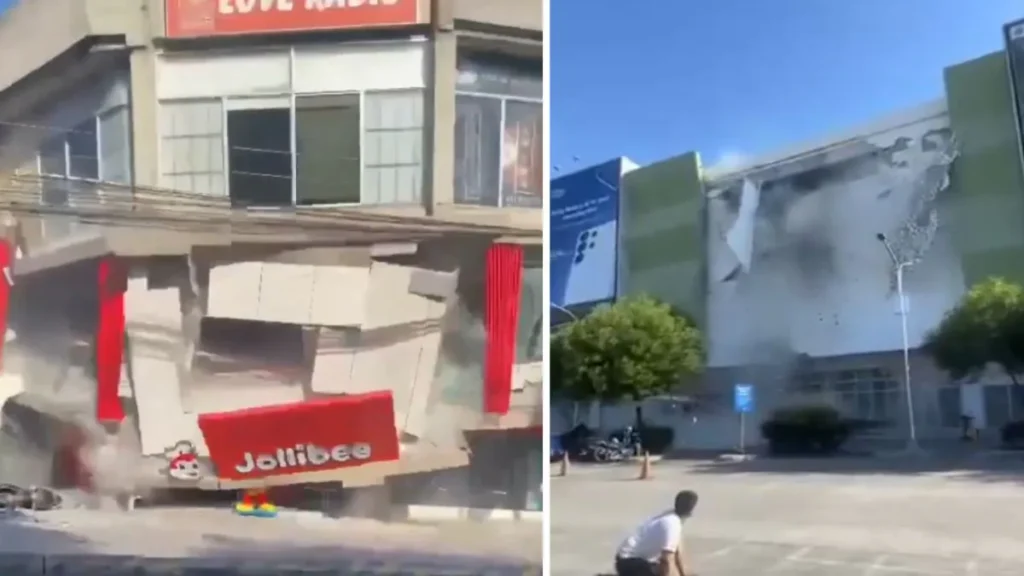
WATCH | 7.8 Earthquake Collapses Buildings in the Philippines’ Mindanao, Coastal Communities Ordered to Evacuate
GENERAL SANTOS, PHILIPPINES — A catastrophic 7.8-magnitude earthquake struck off the southern tip of the Philippines early Monday morning, June 8, 2026, triggering widespread devastation, collapsing commercial buildings and schools, and sparking tsunami warnings across the region. As of the latest reports, at least 15 people have been confirmed dead, and over 129 individuals have sustained injuries in what is being described as one of the strongest seismic events to hit the country in recent years.
The powerful tremor hit the Mindanao region, sending terrified residents and students rushing into the streets as the ground shook violently. Philippine authorities and disaster response agencies have frantically mobilized to rescue those trapped beneath the rubble, while a massive evacuation effort is underway along the coastal communities of the region due to the imminent threat of tsunami waves.
The Quake and Its Immediate Impact
According to the Philippine Institute of Volcanology and Seismology (PHIVOLCS) and the United States Geological Survey (USGS), the earthquake struck at exactly 07:37 a.m. local time. The epicenter was located approximately 26 kilometers west-southwest of Kablalan, just off the coast of Sarangani province in the Soccsksargen region, at a depth of 55.2 kilometers. The violent shaking was felt as far away as Indonesia’s North Sulawesi province and parts of Malaysia.
The disaster struck on what was supposed to be a regular Monday morning, which critically coincided with the first day of the new school year across the Philippines. Millions of students had just returned to their classrooms. At the Mahayahay Elementary School in Davao Occidental, children were participating in a morning flag-raising ceremony when the earth began to heave. Panicked but guided by their teachers, students dropped to the ground and braced themselves. Tragically, a dilapidated building at Matanao National High School collapsed, while students at Cotabato City Central Pilot Elementary School were forced to quickly evacuate after conducting earthquake drills just moments before.
WATCH: Mall crumbles in General Santos City (Gensan) after major earthquake in Philippines pic.twitter.com/Os9KXLFhk9
— Rapid Report (@RapidReport2025) June 8, 2026
General Santos City, a major southern port and commercial hub of over 700,000 people, bore the brunt of the destruction. Social media was quickly flooded with horrifying videos of the disaster unfolding in real-time. Verified footage showed a multistory shopping mall crumbling to the ground in a massive cloud of dust. In another harrowing video, a building housing a popular Jollibee fast-food restaurant and a Love Radio studio was entirely reduced to rubble. Onlookers could be heard screaming in terror as the concrete structures gave way.
“Lord, it has really collapsed! The building has really collapsed!” an eyewitness was heard shouting in a widely circulated video as a school structure toppled. Multiple convenience stores, residential homes, and commercial establishments in General Santos were completely destroyed. Outside Plaza Nova, several vehicles were crushed flat by falling debris.
Rod Sosmeña, regional director of the Office of Civil Defense, confirmed that 12 fatalities occurred in the Soccsksargen region, while three more deaths were recorded in the neighboring Davao Occidental province. At least two people were crushed to death by a collapsing wall in the municipality of Alabel. The casualty count is expected to rise as rescue crews dig through the debris of the collapsed commercial and residential structures.
Tsunami Threat and Mass Evacuations
In the immediate aftermath of the quake, the Pacific Tsunami Warning Center (PTWC) issued an urgent alert, warning that hazardous tsunami waves of up to 3 meters (9.8 feet) were possible along the coasts of the Philippines. Smaller tsunami waves of up to 1 meter were forecasted for the coastlines of Indonesia, Malaysia, Palau, Taiwan, Papua New Guinea, and even parts of Japan.
🚨EARTHQUAKE: Mindanao, Philippines 🇵🇭
— MangoWorxMedia (@MangoWorxMedia) June 8, 2026
A strong shallow earthquake (preliminary magnitude ~7.8 per international agencies like GFZ/USGS; PHIVOLCS initially reported 7.0) struck offshore Sarangani Bay near General Santos City (GenSan), Mindanao, Philippines, at 7:37 AM local… pic.twitter.com/3RFNuVWssx
Recognizing the severe danger, Philippine President Ferdinand Marcos Jr. swiftly ordered the suspension of classes across all affected areas of Mindanao and issued a stern directive for the immediate evacuation of coastal populations.
“Move to higher ground now. Do not wait,” President Marcos Jr. urged the public in a televised address. “Your life is more important than anything left behind. The national government is moving, and we will not leave Mindanao behind.”
Local officials acted quickly. In Kiamba, a coastal municipality near the earthquake’s epicenter, a staggering 80 percent of the town’s 50,000 residents successfully evacuated to higher elevations within hours of the quake. “All the villages along the coast were instructed to proceed to evacuation centers,” said regional disaster chief Agripino Dacera.
The U.S. Embassy in the Philippines also issued a Natural Disaster Alert, advising residents in tsunami warning zones to move farther inland and follow the instructions of local authorities. By mid-afternoon, Malaysia and Indonesia lifted their respective tsunami alerts, though the threat remained active for the southern Philippine shores as tidal gauges measured abnormal wave activity.
Emergency Response and Disrupted Infrastructure
The massive earthquake severely disrupted essential services across Mindanao. Widespread power outages have plunged several municipalities into darkness, while internet and water services have been severed in Koronadal and nearby areas. The international airport in General Santos City was immediately shut down, leading to the cancellation of dozens of domestic flights, pending structural assessments of the runway and terminal buildings.
The Philippine National Police (PNP) deployed over 500 personnel and 23 vehicles to assist in search, rescue, and retrieval operations. The Philippine Red Cross was placed on the highest alert, deploying disaster response teams to assess structural damage, provide medical aid, and coordinate relief efforts at crowded evacuation centers.
Rescue teams face an uphill battle. A series of powerful aftershocks—numbering over 130 in the hours following the initial quake, with the strongest measuring 6.5 in magnitude—have severely hampered rescue operations. Emergency responders have been forced to temporarily abandon their efforts each time the ground shakes, fearing the collapse of already weakened structures. Police and fire officials have cordoned off heavily damaged areas, and officers are not permitted to re-enter their own stations if the buildings display significant cracking.
The Department of Education estimated that the disaster has directly affected over 3.2 million learners and 128,000 teaching personnel across more than 6,200 public schools in the region. The full extent of the damage to the educational infrastructure remains unknown, but it is clear that the recovery process will take months, if not years.
The Philippines, an archipelago nation of over 110 million people, is uniquely vulnerable to natural disasters. It is situated along the infamous Pacific “Ring of Fire,” a volatile horseshoe-shaped band of tectonic faults that encircles the Pacific Ocean. This geologic positioning makes the country highly susceptible to frequent earthquakes and volcanic eruptions. Eastern Mindanao is no stranger to seismic devastation; in late 2025, the region was battered by a pair of 7.4 and 6.7 magnitude earthquakes that caused widespread destruction and loss of life.
As night falls over Mindanao, thousands of displaced families are bracing for a difficult and terrifying evening in makeshift evacuation centers, haunted by the ongoing aftershocks and the devastating loss of their homes and loved ones.