From the Brink of War to the Negotiating Table: Trump Announces Crucial Monday Talks with Iran Amid Gulf Mediation
From the Brink of War to the Negotiating Table: Trump Announces Crucial Monday Talks with Iran Amid Gulf Mediation
WASHINGTON — In a dramatic geopolitical reversal that has momentarily eased global anxieties, United States President Donald Trump has announced that direct negotiations between Washington and Tehran are scheduled to begin on Monday afternoon. The sudden pivot toward diplomacy comes just hours after the world stood on the precipice of a devastating conflict, with the US President revealing that he had called off a massive, unprecedented military strike against Iran at the urgent behest of key Middle Eastern allies.
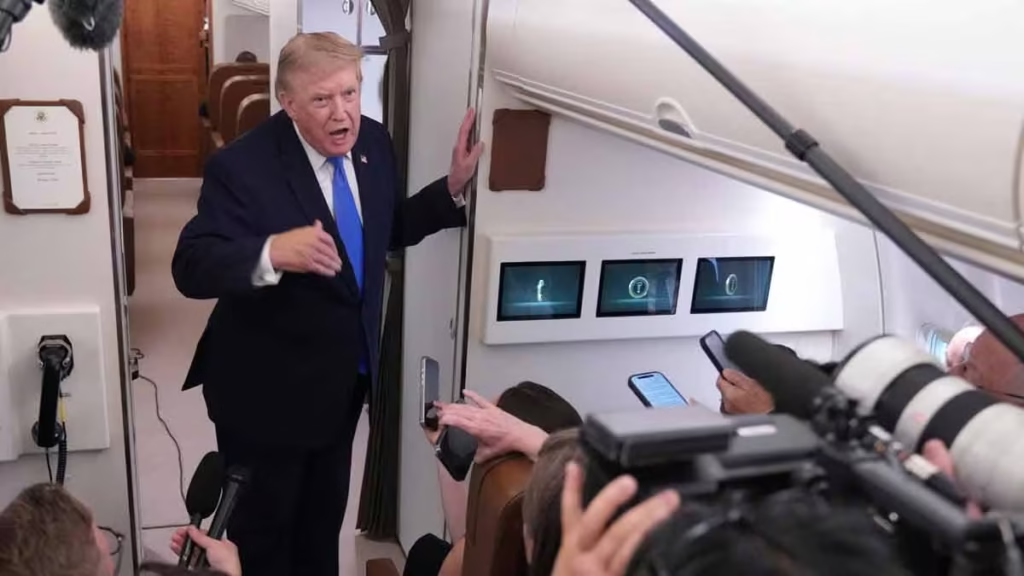
The announcement marks a significant de-escalation in a standoff that has paralyzed international markets and threatened to engulf the entire Persian Gulf in a catastrophic war. Speaking to the traveling press corps aboard Air Force One while en route back to the White House, President Trump detailed the extraordinary sequence of events that transformed a weekend of imminent military action into a renewed pursuit of a diplomatic resolution.
“We are talking to them [the Iranians] in the form of a negotiation; it begins tomorrow afternoon, and we’ll see how it goes,” Trump told reporters, striking a markedly more conciliatory tone than in recent days. “I’d love to do that. It’ll save a lot of lives and a lot of unnecessary power, to be honest with you.”
An Averted Catastrophe: The Aborted Sunday Strike
The most shocking revelation from the President’s airborne press briefing was the sheer scale of the military action that had been planned and ultimately aborted. According to Trump, the US military had finalized preparations for a staggering offensive scheduled for Sunday, which he described as “the biggest attack since World War II.”
While specific tactical details of the planned assault remain classified, the rhetoric implies a widespread, coordinated bombardment likely targeting Iranian military installations, nuclear facilities, and strategic infrastructure. The decision to halt such a monumental operation at the eleventh hour underscores the volatile and rapidly shifting nature of the current administration’s foreign policy.
Only a day prior, the President had publicly expressed immense frustration with Tehran, declaring that he was “losing faith” in the prospect of peaceful negotiations. He had issued a stern warning to the Iranian leadership, stating unequivocally that the US military “will be hitting them very hard.” The rapid transition from preparing an unprecedented bombardment to scheduling diplomatic talks highlights the profound influence of back-channel diplomacy and regional alliances.
The Intervention of Gulf Allies
The crucial turning point in this crisis was not initiated in Washington or Tehran, but in the capitals of neighboring Arab states. President Trump explicitly credited the suspension of the military campaign to urgent appeals from regional powerhouses, specifically naming Qatar, Saudi Arabia, and the United Arab Emirates (UAE).
These Gulf nations, despite their own deep-seated historical and geopolitical rivalries with Iran, recognized that a full-scale US-Iran war would have disastrous consequences for their own borders. A military conflict in the Persian Gulf would almost certainly result in retaliatory strikes, threatening the fragile infrastructure, vital oil refineries, and economic stability of the entire Arabian Peninsula.
“We are ready to go whenever we want. Would I rather make a deal? I’m not looking to kill people, because a lot of people die; we don’t want that,” Trump explained, elaborating on the pressure he received from regional partners. “So they asked us—Iran specifically, but the other three, they asked us.”
The President recounted a specific conversation with the Saudi Crown Prince, illustrating the region’s strong preference for a non-kinetic solution. “I said to the crown prince, ‘What would you rather do? Would you rather us do this or not?’ They said we would much prefer a deal as opposed to an attack, because you don’t know where these attacks lead,” Trump disclosed. This pragmatic approach by the Gulf states highlights a regional consensus that the unpredictable fallout of war far outweighs the frustrations of protracted diplomacy.
The Crux of the Impasse: The Strait of Hormuz
As negotiators prepare to sit down on Monday, the agenda is expected to be dominated by the management and security of the Strait of Hormuz. This narrow maritime chokepoint between the Persian Gulf and the Gulf of Oman is arguably the most strategically critical waterway on the planet. Before the recent escalation of hostilities, approximately one-fifth of the world’s total energy supply flowed through this narrow passage.
Previous attempts at establishing a diplomatic framework between the US and Iran collapsed primarily over fundamentally incompatible visions for the Strait. The Trump administration has drawn a hard line, demanding an ironclad guarantee that the Strait of Hormuz remains permanently open and unhindered for international commercial shipping. The US views freedom of navigation in this corridor as a non-negotiable pillar of global economic security.
Conversely, Tehran has steadfastly maintained that any international arrangement must respect and preserve its sovereign control over the waterway, given its proximity to Iranian shores. Iran has historically used its position along the Strait as geopolitical leverage, implicitly and explicitly threatening to disrupt global oil supplies when faced with intense international pressure or crippling economic sanctions. Bridging the gap between the US demand for unfettered international access and Iran’s insistence on sovereign jurisdiction will be the primary hurdle for negotiators.
Denuclearization and the Path Forward
Beyond the immediate crisis in the Strait of Hormuz, President Trump indicated that any emerging, comprehensive agreement must also address the long-standing issue of Iran’s nuclear ambitions. The United States is seeking a definitive resolution to its concerns regarding the Iranian nuclear program, aiming for a broader denuclearization pact that ensures Tehran cannot develop nuclear weapons capabilities.
As the world watches with bated breath, the stakes for the upcoming Monday talks could not be higher. The diplomatic teams are tasked with defusing a geopolitical time bomb. If the negotiations succeed, it could pave the way for a new security architecture in the Middle East, stabilize global energy markets, and secure the vital shipping lanes of the Strait of Hormuz. If they fail, the alternative—as vividly described by the US President’s aborted weekend plans—is an unprecedented military confrontation whose devastating ripples would be felt across the globe.
Tags: