‘There Is No Pakistani Kashmir’: India Rebukes The New York Times Over Misleading Headline on PoK Unrest
‘There Is No Pakistani Kashmir’: India Rebukes The New York Times Over Misleading Headline on PoK Unrest
WASHINGTON D.C. / NEW DELHI — In a sharp and unequivocal diplomatic pushback, the Government of India has formally objected to a recent headline published by the prominent American newspaper, The New York Times. The controversy centers on the publication’s use of the term “Pakistani Kashmir” to describe the region of Pakistan-Occupied Kashmir (PoK) in a report detailing recent violent clashes and local elections in the area. The Indian Embassy in the United States took to social media to firmly reject the terminology, categorizing it as “misleading and incorrect” and reiterating India’s sovereign territorial claims over the entire region.
The diplomatic friction was triggered by a New York Times news report that examined the escalating unrest and heavily contested local elections in Pakistan-Occupied Kashmir. The newspaper’s headline explicitly used the phrase “Pakistani Kashmir,” a term that New Delhi argues grants undue legitimacy to what it considers an illegal and forceful occupation by Islamabad.
On Wednesday, July 29, 2026, the Indian Embassy in Washington D.C. responded robustly via a post on X (formerly Twitter). The diplomatic mission did not mince words, directly tagging the publication in its critique. “Misleading and incorrect headline by @nytimes,” the embassy posted. “There is no Pakistani Kashmir, only Pakistan-occupied Kashmir.”
The statement went on to reiterate India’s foundational and unyielding geopolitical stance regarding the northern territories. “The Union Territories of Jammu & Kashmir and Ladakh, have been, are and will always remain an integral and inalienable part of India. Pakistan has illegally occupied parts of these territories and is now using violence against the occupied people,” the embassy declared.
This objection is not a mere debate over semantics; for India, the terminology used by international media organizations carries profound geopolitical weight. The Government of India has consistently rejected terms such as “Azad Kashmir” (Free Kashmir) or “Pakistani Kashmir,” which are frequently utilized by Islamabad and occasionally adopted by Western media outlets. New Delhi insists that the entire former princely state of Jammu and Kashmir legally acceded to the Dominion of India in 1947, rendering Pakistan’s administration of the western and northern portions of the region an unauthorized and illegal military occupation.
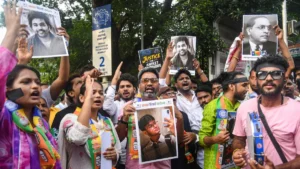
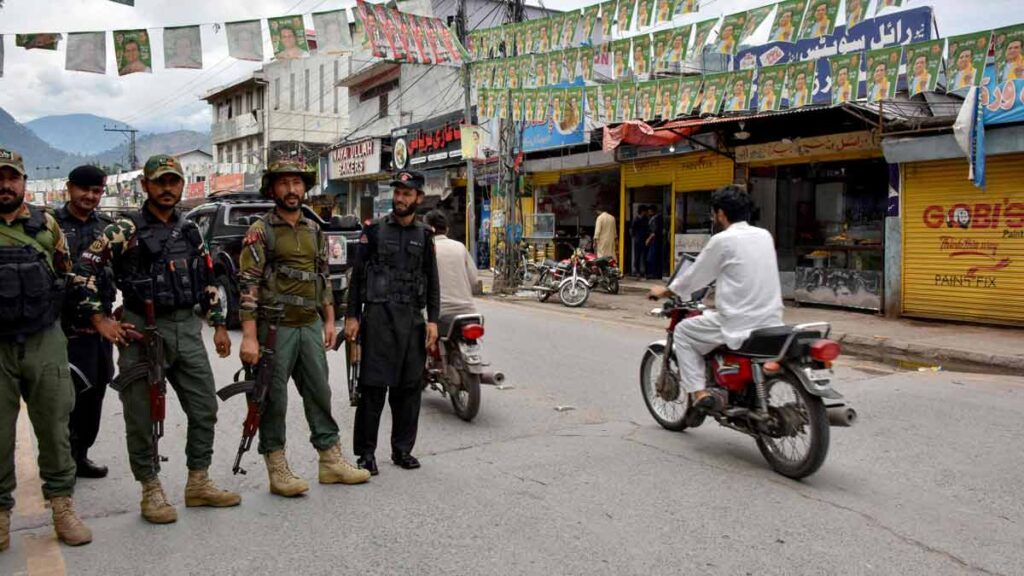
The New York Times report in question focused on a wave of intense violence that has rocked PoK, specifically centering on the city of Mirpur. According to the publication and various on-ground reports, fierce clashes erupted between local security forces and members of the Joint Awami Action Committee (JAAC). The JAAC, a prominent civil rights and activist group in the region, has been spearheading massive protests over 12 contentious legislative assembly seats and demonstrating against alleged police excesses and systemic oppression.
The unrest, which has been brewing since early June 2026, recently culminated in a brutal crackdown. The New York Times reported that the violence on the first day of a contested vote resulted in multiple fatalities, with at least two people dying from gunshot injuries during the latest confrontations in Mirpur. However, broader independent estimates and local officials cited in earlier reports suggest that the death toll over the prolonged period of unrest has crossed 30, encompassing protesters, security personnel, and civilian bystanders.
The Indian Embassy’s statement cleverly pivoted the narrative away from a simple territorial dispute to a human rights issue, highlighting Pakistan’s use of “violence against the occupied people.” This aligns with New Delhi’s broader strategy of drawing global attention to the deteriorating humanitarian situation in PoK. The heavy-handed response by Pakistani security forces during the long march organized by the JAAC has also drawn the ire of human rights organizations. The Human Rights Commission of Pakistan recently issued a statement calling for a thorough and impartial investigation into the deaths of civilians, further validating claims of administrative brutality and police excesses in the region.
India has frequently characterized the electoral exercises conducted by Pakistan in PoK as farcical. According to the Ministry of External Affairs in New Delhi, such local elections represent a transparent attempt by Islamabad to camouflage its illegal occupation and hide “grave” human rights violations from the international community. The Indian government asserts that these administrative maneuvers hold no legal validity and are merely designed to artificially alter the demographic and political realities of the occupied territories.
The swift rebuttal to The New York Times is part of a broader, more assertive Indian foreign policy framework that actively monitors and challenges the international narrative surrounding its borders. This approach has been visible not only in dealing with the global press but also in multilateral forums. For instance, just a month prior, on June 24, 2026, India raised strong objections at a United Nations forum in New York. Ambassador Parvathaneni Harish, India’s Permanent Representative to the UN, forcefully countered Pakistan’s attempt to raise the Kashmir issue, explicitly stating that the Union Territory of Jammu and Kashmir is an internal matter of India and rejecting any external interference or commentary on the subject.
Following the abrogation of Article 370 and the passing of the Jammu and Kashmir Reorganisation Act in 2019, which bifurcated the former state into the two Union Territories of Jammu & Kashmir and Ladakh, India has doubled down on its diplomatic efforts to ensure the international community uses correct geographical and political terminology. By actively challenging publications like The New York Times, New Delhi is sending a clear message that it will not tolerate the normalization of language that undermines its sovereignty.
As the situation in Pakistan-Occupied Kashmir remains volatile, with ongoing civil unrest and alleged state-sponsored violence, the international community continues to watch closely. However, India has drawn a definitive red line regarding how the region is portrayed in the global domain. For the Indian government, the equation remains unequivocally clear: the territory in question is under illegal occupation, and the international press must reflect this reality by abandoning terms that inadvertently validate cross-border aggression.