“I Take Full Responsibility”: CRPF Chief Backs Troops Amid Political Backlash Over NEET Protest Crackdown
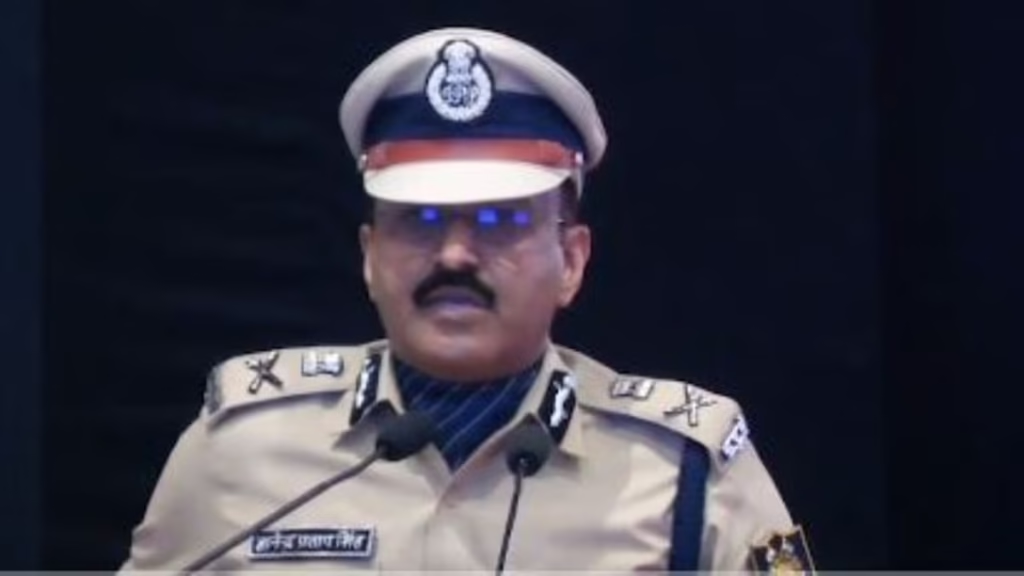
"I Take Full Responsibility": CRPF Chief Backs Troops Amid Political Backlash Over NEET Protest Crackdown
NEW DELHI — In a robust display of institutional defense, the Director General of the Central Reserve Police Force (CRPF), Gyanendra Pratap Singh, has delivered a strong message of reassurance to his personnel, telling them to execute their duties “without fear.” This statement, which emphasized that he would “take full responsibility” for their actions, comes amid a fierce political and public backlash over allegations that the Rapid Action Force (RAF)—a specialized anti-riot wing of the CRPF—used excessive force, including controversial plastic pellets, against students protesting the NEET exam paper leaks in Delhi.
Speaking at a recent CRPF investiture ceremony, DG Gyanendra Pratap Singh addressed the growing controversy head-on, seeking to boost the morale of the paramilitary forces operating under intense scrutiny. His remarks were notably direct, framing the actions of his personnel as being fundamentally in the “national interest.”
“As the Director General of the CRPF, I want to assure each one of you that whether it is our operational battalions or law and order units, whatever decisions you take and whatever actions you take in the national interest, public interest, and the interest of the force, provided they are in the honest discharge of your duty, I take full responsibility for all those decisions and actions,” Singh declared during the formal event.
The statement, which was subsequently shared and circulated on social media platforms including X (formerly Twitter) by news agencies, has injected a new layer of complexity into an already volatile political situation.
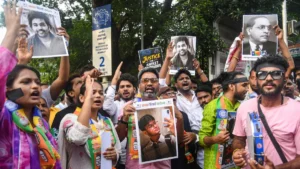
The controversy stems from the violent clashes that erupted on July 20, 2026, when thousands of students and youth activists, heavily backed by opposition political parties and civil rights groups, converged in the national capital to protest widespread irregularities and alleged paper leaks in the NEET-UG medical entrance examination. The situation quickly escalated, leading to a heavy-handed police and paramilitary response.
The political flashpoint ignited when reports and harrowing visuals emerged suggesting that some protesters had sustained grievous injuries, allegedly from the use of plastic pellets fired by riot control forces. The use of pellet guns, even those firing plastic projectiles, has long been a highly contentious issue in India, usually associated with crowd control in conflict zones like Kashmir rather than student demonstrations in the heart of Delhi.
Opposition leaders, including Lok Sabha Opposition leader Rahul Gandhi, have forcefully condemned the crackdown. Gandhi recently reiterated his demand for the dismissal of Home Minister Amit Shah and called for a Supreme Court-monitored investigation into the police violence at the Jantar Mantar protests. Youth leaders spearheading the anti-NEET demonstrations, such as Abhijeet Dipke, have also warned of “bigger” protests if the government does not cease harassing those who participated in the initial demonstrations. Dipke specifically demanded action against the officials who ordered the deployment of pellet guns against unarmed students.
Despite the mounting public outrage, the CRPF leadership has firmly stood its ground. According to internal post-incident assessments conducted by the paramilitary force, all standard operating procedures (SOPs) and established protocols were strictly adhered to by the RAF personnel during the police action on July 20. The official stance maintains that the use of force was a necessary and proportional response to maintain law and order when the protests threatened to spiral out of control.
However, contradictory reports regarding the deployment of crowd-control weapons have only deepened the controversy. According to various media reports citing official sources, at least a dozen Rapid Action Force personnel were indeed issued pellet guns on the morning of July 20 as they deployed to manage the student protesters. Yet, following the immediate public and political outcry over their alleged use, these controversial weapons were quietly withdrawn from active deployment starting July 23. This tactical retreat on the ground contrasts sharply with the public backing offered by the CRPF chief, suggesting a delicate balancing act between maintaining troop morale and managing public optics.
DG Singh’s assurance to his troops that they can perform their duties “without fear” of repercussions is being viewed by some as a necessary leadership intervention to prevent operational paralysis within the ranks. When security personnel face intense media scrutiny and the threat of legal or departmental inquiries for actions taken in volatile crowd-control situations, morale can plummet, leading to hesitation in future crises. By publicly absorbing the responsibility, Singh aims to shield his foot soldiers from the political fallout.
Conversely, civil rights activists and opposition leaders interpret the CRPF chief’s statement as a dangerous blanket immunity that could embolden law enforcement agencies to act with impunity. Critics argue that assuring troops of “full responsibility” from the top brass might undermine the necessary checks and balances, potentially encouraging disproportionate responses against democratic protests in the future.
The NEET paper leak controversy has evolved from an educational scandal into a multifaceted crisis involving allegations of corruption, widespread youth disillusionment, and now, debates over police brutality and state repression. With students moving the Supreme Court over various grievances related to the National Testing Agency (NTA) and opposition parties refusing to let the issue die down in Parliament, the political temperature remains high.
As the government attempts to navigate the fallout—having recently instituted an expert panel led by Infosys co-founder Nandan Nilekani to advise on NTA reforms—the focus on the CRPF’s actions ensures that the issue of state response to public dissent remains front and center. DG Gyanendra Pratap Singh’s bold assumption of responsibility may have reassured his troops, but it has also guaranteed that the CRPF will remain firmly in the political crosshairs in the days to come.