Massive Jolt to Mamata Banerjee: 20 Rebel TMC MPs Set to Join NDA, Threaten Trinamool’s ‘Jora Phool’ Symbol
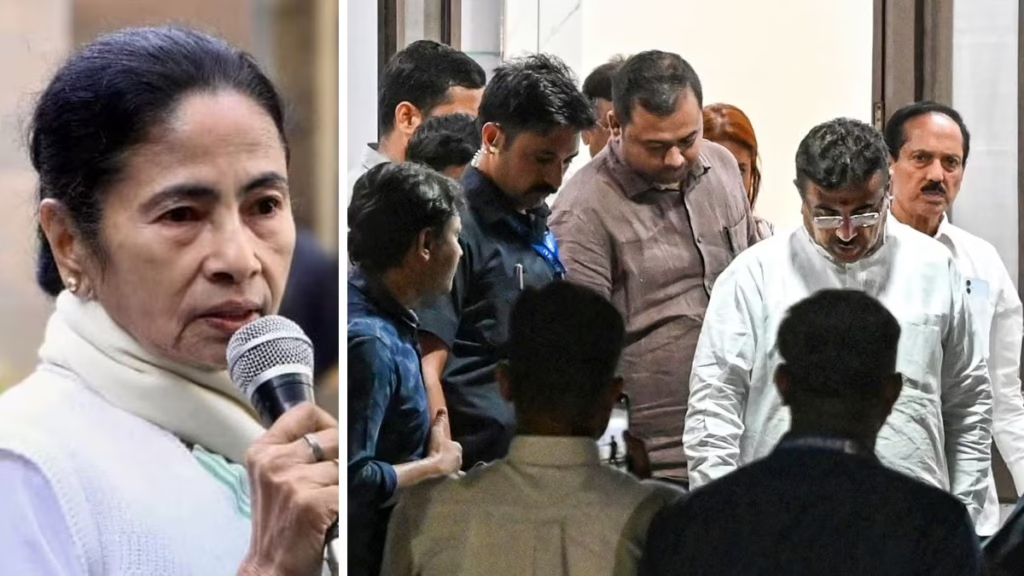
Massive Jolt to Mamata Banerjee: 20 Rebel TMC MPs Set to Join NDA, Threaten Trinamool's 'Jora Phool' Symbol
In a seismic political development that threatens to reshape the landscape of Indian national politics, the Trinamool Congress (TMC) is facing an unprecedented existential crisis. A massive rebellion within the party ranks, spearheaded by 20 rebel Members of Parliament (MPs), has paved the way for a major defection to the Bharatiya Janata Party (BJP)-led National Democratic Alliance (NDA). This large-scale exodus not only bolsters the NDA’s numbers in the Lok Sabha past the crucial 300-member mark but also places TMC supremo Mamata Banerjee in real danger of losing her iconic ‘Jora Phool’ (twin flowers) election symbol. As the rebel faction maneuvers to align itself with the ruling coalition at the Centre, the political shockwaves are being felt from Kolkata to New Delhi.
The NDA’s March Past the 300-Mark
The sheer mathematics of this defection fundamentally alters the power dynamics in the lower house of Parliament. Currently, the BJP-led NDA commands a solid majority with 292 MPs in the Lok Sabha. The infusion of the 20 rebel TMC MPs will comfortably push the coalition’s tally to 312, providing the ruling alliance with a profound psychological and numerical advantage.
The rebel camp, operating under the leadership of TMC Chief Whip Kakoli Ghosh Dastidar, has formally set the wheels in motion. They have communicated their intentions directly to Lok Sabha Speaker Om Birla’s office, officially requesting permission to sit separately in the House. Furthermore, the rebel MPs have explicitly declared their intention to lend their support to, and ultimately join, the NDA.
Despite this significant boost, parliamentary arithmetic indicates that the NDA still falls short of the elusive two-thirds majority required to unilaterally pass sweeping constitutional amendment bills. Key legislative goals—such as expanding the number of parliamentary seats, implementing women’s reservation, or executing the ambitious ‘One Nation, One Election’ framework—will still require broader consensus. Consequently, political speculations are rife that the BJP is actively courting other regional players to bridge this gap. Reports suggest the saffron party is eyeing potential support from eight MPs belonging to the Uddhav Thackeray-led Shiv Sena (UBT), eight from the Sharad Pawar-led NCP(S), four from the YSR Congress, and single representatives from both the Shiromani Akali Dal and the Zoram People’s Movement.
The Delhi Meeting: Orchestrating the Exodus
The defection strategy was solidified during a crucial high-level meeting held in New Delhi on Monday. The rebel TMC parliamentarians met with senior BJP leader Bhupendra Yadav to chart out their political future. Crucially, this meeting took place in the presence of West Bengal Chief Minister Suvendu Adhikari, underscoring the BJP’s direct involvement in orchestrating this massive political realignment.
The list of attendees at this pivotal meeting reads like a who’s who of the Trinamool Congress’s parliamentary leadership. Alongside Kakoli Ghosh Dastidar, the delegation included prominent figures such as Prasun Banerjee, Asit Mal, Bapi Halder, June Malia, Jagadish Chandra Verma Basunia, Kalipada Soren, Arup Chakraborty, Partha Bhowmik, and Sharmila Sarkar. Adding star power to the rebellion, the names of celebrity-turned-politicians Yusuf Pathan, Rachana Banerjee, and Dev have also surfaced in the rapidly expanding list of defectors, highlighting the deep fractures within Mamata Banerjee’s previously iron-clad political fortress.
The Battle for the ‘Jora Phool’
Beyond the immediate loss of parliamentary strength, the defection poses a severe, existential legal threat to Mamata Banerjee’s control over the Trinamool Congress itself. Political analysts and legal experts point out that it is only a matter of time before the rebel faction stakes a formal claim over the party’s name and its highly recognizable ‘Jora Phool’ election symbol.
Under the stringent guidelines of the Election Commission of India (ECI), the allocation of a party symbol in the event of a split is determined by a test of majority. If a breakaway faction can prove that it commands the support of the majority of the party’s elected representatives—across the Legislative Assembly, Lok Sabha, Rajya Sabha, and local municipal and panchayat bodies—as well as the backing of key party office-bearers, they can legally claim to be the “real” party.
In the context of the Lok Sabha, the rebels have executed a mathematically precise maneuver. To safely bypass the punitive measures of the anti-defection law—which mandates the disqualification of defecting MPs unless they constitute at least two-thirds of the parliamentary party—the rebels needed the allegiance of 19 MPs. By successfully rallying 20 MPs, the Kakoli Ghosh Dastidar-led faction has legally insulated itself from disqualification. If the ECI legally recognizes this split, this group could swiftly declare themselves the genuine Trinamool Congress, leaving Mamata Banerjee facing the devastating prospect of fighting future elections without the symbol that has defined her political career for decades.
The Assembly Connection and Political Fallout
The crisis in Delhi is unfolding against the backdrop of an ongoing political upheaval within the West Bengal Legislative Assembly. However, the exact coordination between the two rebellions remains a subject of intense political debate. Ritabrata Banerjee, recognized as the mastermind behind the recent TMC split in the state Assembly, has publicly distanced himself from the parliamentary mutiny in Delhi. “I or we have nothing to do with the decision taken by the MPs in Delhi. Our position is clear. We will not take any position that will benefit the BJP,” he stated, adding that his faction will operate openly and judge government actions on their individual merits.
Unsurprisingly, the Mamata Banerjee loyalist camp has vehemently accused the BJP of engineering the entire crisis to destabilize the opposition. Kunal Ghosh, a staunch TMC MLA from Beleghata, did not mince words when addressing the dual rebellions. “The BJP is the sponsor in both cases. In Delhi, openly. Here (in the assembly) quietly,” Ghosh alleged, framing the defections as a calculated, saffron-funded assault on regional democratic mandates.
As the political drama continues to unfold, the stakes could not be higher. The potential loss of 20 MPs and the very symbol of her party represents the most severe challenge to Mamata Banerjee’s political authority since the formation of the Trinamool Congress. As the NDA inches closer to absolute parliamentary dominance, the political survival of one of India’s most formidable regional leaders hangs precariously in the balance.