Conflicting Narratives Emerge as Trump Declares “End to War with Iran” While Tehran Cites “Speculation”
Conflicting Narratives Emerge as Trump Declares "End to War with Iran" While Tehran Cites "Speculation"
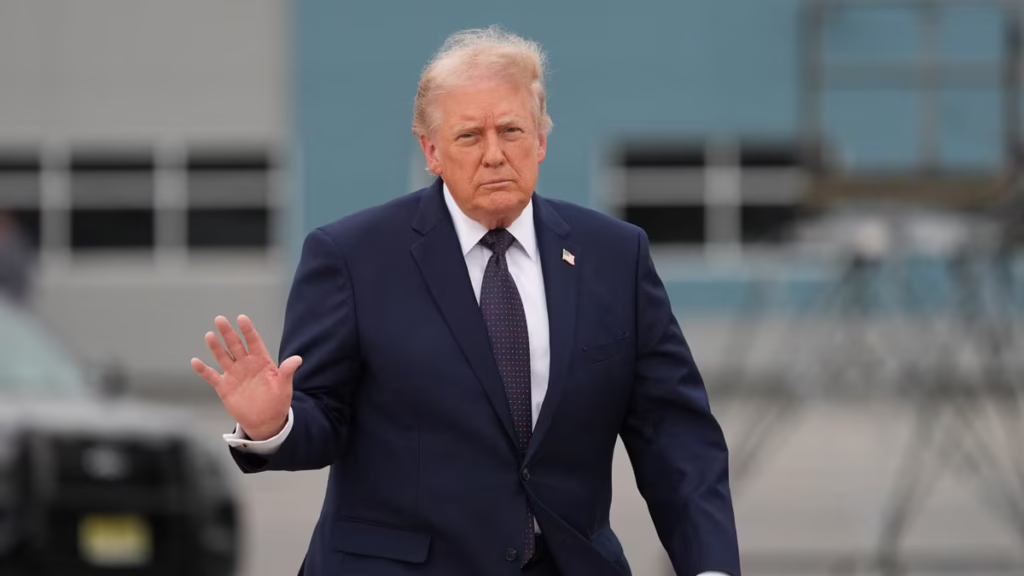
In a dramatic and rapidly unfolding diplomatic development, United States President Donald Trump announced on Thursday that the United States has officially “ended the war with Iran.” According to the President, a comprehensive peace agreement is imminent and will soon be finalized in Europe. However, the sweeping declarations emanating from Washington stand in stark contrast to the cautious and decidedly skeptical tone coming out of Tehran. Iranian officials have swiftly pushed back against the American narrative, dismissing reports of a finalized deal as “merely speculation” and insisting that no ultimate decision has been reached regarding the much-anticipated accord.
The monumental claim regarding the cessation of hostilities was first made by President Trump during a brief telephone interview with The New York Post. In the call, the President projected a strong sense of finality regarding the ongoing conflict, stating simply, “It’s pretty much all wrapped up.” This declaration followed closely on the heels of emerging reports suggesting that Iranian officials had submitted a final draft of a prospective agreement to Qatari mediators on Wednesday night.
Taking to his social media platform, Truth Social, President Trump elaborated on the situation, painting a picture of a broad, multi-nation consensus. He announced that he had personally intervened to halt imminent military action. “Based on the fact that discussions with the Islamic Republic of Iran have been brought to the highest level of Iranian leadership and approved, I have, as president of the United States of America, cancelled the scheduled strikes and bombings against Iran this evening,” he wrote.
Trump further claimed that the framework of the agreement—both in overarching concept and intricate detail—had garnered the approval of a wide coalition of regional and global actors. According to the President, the consenting parties include not just the United States and Iran, but also Israel, Saudi Arabia, the United Arab Emirates, Qatar, Turkey, Pakistan, Bahrain, Kuwait, Jordan, and Egypt. The inclusion of such a diverse array of Middle Eastern and allied nations underscores the vast geopolitical ramifications that a finalized treaty would entail.
Despite the halt on aerial bombardments, Trump clarified that the United States would not immediately lift all punitive measures. He emphasized that the robust naval blockade currently imposed on Iran will “remain in full force and effect” until the transaction is definitively finalized and signed. Looking ahead to the formalization of the treaty, the President suggested that Vice President J.D. Vance could travel to Europe in the coming days to represent the United States at the signing ceremony.
The President doubled down on his assertions later in the day during a political rally in Georgia, where he was supporting Lieutenant Governor Burt Jones’s gubernatorial campaign. “I don’t know if you heard, but we ended the war with Iran today,” Trump told the crowd. He highlighted the non-proliferation aspect of the supposed deal as its crowning achievement. “They have agreed never to have a nuclear weapon, something that we insisted on; that was the whole purpose. That was 95 per cent of it,” he declared to his supporters.
In sharp juxtaposition to the celebratory mood in the Trump administration, Iran has steadfastly refused to confirm that an agreement has been finalized. The messaging from Tehran reflects a profound caution and a clear desire to temper expectations.
Esmail Baghaei, the spokesperson for Iran’s Foreign Ministry, addressed the situation directly through the state-run Islamic Republic News Agency (IRNA). Baghaei unequivocally labeled the reports of a completed agreement with the United States as “merely speculation.” He stressed that the Iranian government has yet to make a final, binding decision on any proposed diplomatic framework.
“From the beginning, the status of the negotiations was clear to us, and a large portion of the text had already been finalized. However, the Americans kept changing their positions,” Baghaei remarked, highlighting the deep-seated mistrust that continues to characterize bilateral relations between the two nations. “So far, Iran has not reached a final decision regarding any agreement.”
Crucially, Baghaei reiterated Tehran’s commitment to its non-negotiable strategic priorities. He stated that the Islamic Republic has “proven that it does not compromise on what it has defined as its red lines.” This insistence on maintaining strict boundaries suggests that while diplomatic backchannels are highly active, the fundamental ideological and strategic gaps between Washington and Tehran may still pose significant hurdles to a lasting peace.
The conflicting narratives highlight the delicate and often opaque nature of high-stakes international diplomacy. According to regional sources quoted by The New York Post, Iran did, in fact, finalize its latest draft of a proposed agreement and submitted it to intermediaries in Doha. “The text of the agreement was completed and finalized on Wednesday evening,” a regional source familiar with the Iranian leadership disclosed. Qatar has played an instrumental role as a primary facilitator, maintaining constant contact with both Tehran and Washington in an effort to bridge the divide. “If final approval is granted, the implementation process of the understanding will begin,” the source added.
The urgency of these diplomatic maneuverings cannot be overstated. Up until these recent pronouncements, the relationship between the two adversaries had deteriorated into direct kinetic confrontation. Reports indicate that Iran and the United States had been actively engaging in military hostilities, including the exchange of missile fire, pushing the Middle East to the precipice of a full-scale regional war. The cancellation of US strikes and the reported diplomatic progress represents a critical pause in a highly volatile cycle of escalation.
The sheer scale of the coalition Trump claimed has approved the deal would represent an unprecedented diplomatic alignment if accurate. For decades, the geopolitical architecture of the Middle East has been defined by the rivalry between Iran and a US-backed bloc of Arab states and Israel. A comprehensive treaty that satisfies the security demands of regional powers while simultaneously addressing Iran’s economic imperatives would rewrite the strategic map of the region.
However, the historical context of the Iranian nuclear issue casts a long shadow over the current proceedings. Securing an airtight commitment that Iran will never acquire nuclear capabilities would be a legacy-defining achievement for the administration. Yet, for Iran, the negotiations are inextricably linked to regime survival, economic relief from crippling sanctions, and regional influence.
As Qatari mediators continue their delicate shuttle diplomacy, the world waits to see if the rhetoric will match reality. Until a formal signing ceremony takes place, the true status of the peace accord remains suspended between American confidence and Iranian caution.