President Appoints Five New Supreme Court Judges, Taking Working Strength to 37
President Appoints Five New Supreme Court Judges, Taking Working Strength to 37
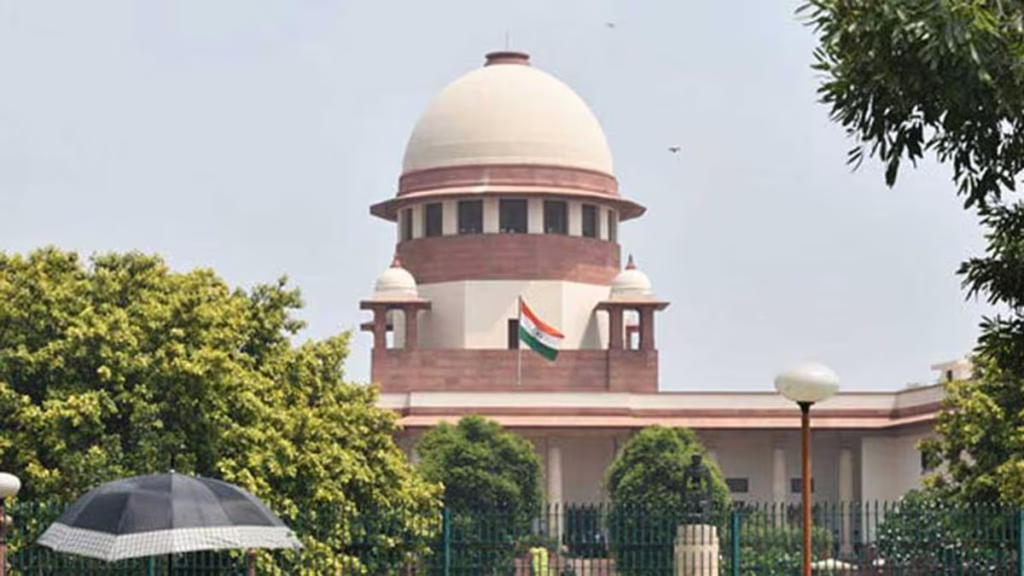
NEW DELHI — In a major development for the Indian judiciary, President Droupadi Murmu on Monday, June 1, 2026, cleared the appointment of five new judges to the Supreme Court of India. The new appointments include four incumbent Chief Justices of various High Courts and one senior advocate directly elevated from the Bar. This decisive move comes on the heels of the Supreme Court Collegium’s recommendations made just days earlier on May 27 and brings the apex court’s working strength to 37, just one short of its newly expanded sanctioned capacity of 38 judges.
The Ministry of Law and Justice issued separate notifications on Monday morning confirming the elevations. The swearing-in ceremony, which is expected to be administered by Chief Justice of India (CJI) Surya Kant, is slated for June 2. The swift approval by the Union government—clearing all five names within a span of four days—highlights a coordinated effort between the executive and the judiciary to address the pressing issue of judicial vacancies and mounting case pendency at the highest level.
Profiles of the Appointees
The newest additions to the Supreme Court bench bring a wealth of diverse legal and judicial experience from across the country.
Justice Sheel Nagu: Prior to this elevation, Justice Nagu served as the Chief Justice of the Punjab and Haryana High Court, a position he assumed in July 2024. Born on January 1, 1965, he enrolled as an advocate in 1987, practicing extensively in constitutional, civil, and service matters. He was appointed as a judge of the Madhya Pradesh High Court in May 2011, where he later served as the Acting Chief Justice. Notably, Justice Nagu was a member of the three-judge in-house inquiry committee that investigated the controversial cash-at-home case involving a former Delhi High Court judge. He is scheduled to serve in the Supreme Court until his retirement on December 31, 2029.
Justice Shree Chandrashekhar: Elevated from his role as the Chief Justice of the Bombay High Court, Justice Chandrashekhar was born on May 25, 1965, in Ranchi. A law graduate from Delhi University’s Campus Law Centre, he enrolled with the Delhi Bar Council in 1993. He became an additional judge of the Jharkhand High Court in January 2013, eventually becoming its Acting Chief Justice before being transferred to the Rajasthan High Court, and subsequently to the Bombay High Court in September 2025. Justice Chandrashekhar will serve in the apex court until May 24, 2030.
Justice Sanjeev Sachdeva: Justice Sachdeva transitions to the Supreme Court from his tenure as the Chief Justice of the Madhya Pradesh High Court. Born on December 26, 1964, he is a graduate of the prestigious Sri Ram College of Commerce and the Campus Law Centre, Delhi University. Qualifying as an Advocate-on-Record in the Supreme Court in 1995, he has built a formidable reputation in corporate and constitutional litigation. He will have a tenure of approximately three and a half years at the Supreme Court.
Justice Arun Palli: Having served as the Chief Justice of the High Court of Jammu and Kashmir and Ladakh since April 2025, Justice Palli brings critical experience from a highly sensitive and complex judicial zone. His elevation ensures representation and perspective from the northernmost jurisdictions of the country. He is expected to have a tenure of three years and four months in the top court.
A Historic Milestone for Women in the Judiciary
Perhaps the most notable of the five appointments is the elevation of Senior Advocate Venkita Subramani Mohana. Her appointment is historic on multiple fronts. She becomes only the second woman in the history of independent India to be elevated directly from the Bar to the Supreme Court Bench, following in the footsteps of Justice Indu Malhotra, who broke the glass ceiling in 2018.
Furthermore, Justice Mohana will be the 12th woman to serve as a Supreme Court judge and will join Justice B.V. Nagarathna, bringing the total number of sitting female judges in the current Supreme Court back to two. No woman had been appointed to the apex court since the historic swearing-in of three female judges in August 2021.
A first-generation lawyer hailing from Coimbatore, Mohana graduated with a law degree in 1988 and has practiced continuously for over 37 years. She became an Advocate-on-Record in 1996 and was designated as a Senior Advocate by the Supreme Court in April 2015. Her direct elevation is seen as a significant step toward addressing the historic gender disparity in the higher echelons of the Indian judiciary.
Expanding the Apex Court’s Capacity
These appointments follow a critical legislative maneuver by the central government. In May 2026, the Centre promulgated the Supreme Court (Number of Judges) Amendment Ordinance, effectively increasing the sanctioned strength of the top court from 34 to 38 (including the Chief Justice of India). The expansion created six immediate vacancies, accounting for pre-existing retirements and the newly added seats.
The push to expand the bench is a direct response to the staggering backlog of cases. With thousands of Special Leave Petitions, constitutional challenges, and appellate matters pending, the additional judicial manpower is expected to allow the constitution of more Division and Constitution Benches. This will accelerate the disposal rate and streamline the delivery of justice. With these five appointments, the working strength immediately jumps from 32 to 37, rendering the court nearly fully functional under its new capacity.
The Collegium’s Decisive Action
The successful appointments represent the first major set of elevations under the leadership of Chief Justice of India Surya Kant, who assumed office in November 2025. The Supreme Court Collegium—comprising CJI Kant and Justices Vikram Nath, J.K. Maheshwari, B.V. Nagarathna, and M.M. Sundresh—finalized the recommendations after a marathon preliminary meeting on May 22, culminating in the formal resolution on May 27.
The seamless and rapid approval by the Ministry of Law and Justice averts the customary friction and delays often witnessed between the Collegium and the executive over judicial appointments.
As the new judges prepare to take their oaths, the Supreme Court of India steps into a new phase. Armed with an expanded bench and a blend of seasoned high court chief justices and a distinguished member of the Bar, the top court is better positioned to navigate the complex legal challenges of the modern era while making a meaningful dent in its historic pendency.