Gautam Adani’s Big Move: Why Adani Ports Is Reportedly Eyeing the UK’s Largest Port Operator
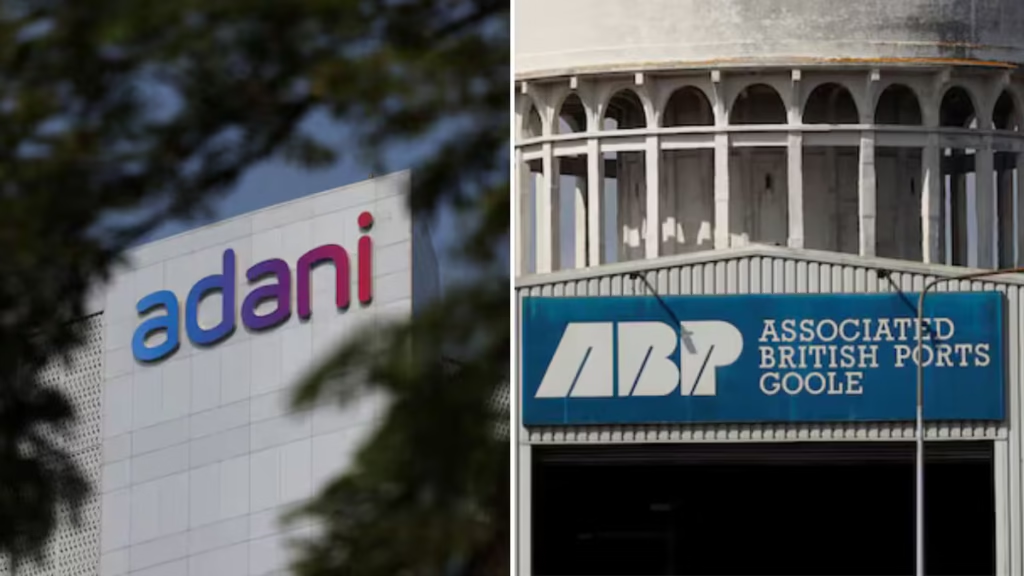
Gautam Adani’s Big Move: Why Adani Ports Is Reportedly Eyeing the UK’s Largest Port Operator
LONDON / AHMEDABAD — The global maritime industry is buzzing with speculation as India’s largest private port operator, Adani Ports and Special Economic Zone (APSEZ), is reportedly evaluating a massive bid for Associated British Ports (ABP), the United Kingdom’s most critical port operator. The potential deal, estimated to be valued at over £10 billion (roughly ₹1.07 lakh crore), would mark the Gautam Adani-led conglomerate’s biggest international infrastructure acquisition to date and its first major investment on British soil.
The speculation gained momentum after reports surfaced that Canadian pension giants CPP Investments (CPPIB) and the Ontario Municipal Employees Retirement System (OMERS), which collectively hold a controlling 63.9% stake in ABP, have initiated a sale process and hired bankers.
When questioned about the potential acquisition, Adani Ports neither confirmed nor outright denied the rumors. In a standard regulatory filing, an APSEZ spokesperson stated, “The Company continuously evaluates opportunities that align with our long-term strategy and create sustainable value for all stakeholders.” The company further added that it does not comment on “market speculation or rumours” as a matter of policy, emphasizing that any mandatory disclosures would be made to the stock exchanges as required by law.
Why ABP is a Prize Catch
Associated British Ports is not just another port company; it is the backbone of the United Kingdom’s maritime trade and energy infrastructure.
Owning and operating 21 bustling ports across England, Scotland, and Wales, ABP handles approximately a quarter of all UK seaborne trade. Its crown jewels include the Port of Southampton, which is the nation’s biggest export hub moving around £40 billion worth of goods annually, and the Port of Immingham, the UK’s largest port by tonnage.
Beyond traditional cargo, ABP is deeply intertwined with the UK’s green energy transition. It serves as the operations and maintenance base for over 50% of the UK’s offshore wind sector. For a company like APSEZ, which has been vocal about expanding its footprint in offshore marine services, this makes ABP a highly strategic target.
Financially, ABP is a powerhouse. A significant portion of its revenue is secured through long-term customer contracts that guarantee income regardless of daily traffic fluctuations. Furthermore, ABP acts as the statutory harbour and river authority for most of its ports, allowing it to generate substantial, steady revenue from pilotage and conservancy services.
The Strategic Fit for Adani Ports
For APSEZ, acquiring a controlling stake in ABP aligns perfectly with its aggressive global expansion strategy. APSEZ is already a behemoth in India, managing 15 ports with a combined capacity of about 653 million metric tonnes per annum (MTPA) and handling a record 500.8 MTPA in the last fiscal year.
However, the company’s vision stretches far beyond Indian shores. APSEZ aims to handle one billion tonnes of cargo annually by 2030 and position itself as the world’s biggest transport utility by 2031. It has already begun planting its flag globally, holding operational stakes in the Haifa Port in Israel, Dar es Salaam in Tanzania, the Colombo West International Terminal in Sri Lanka, and the North Queensland Export Terminal in Australia.
Securing ABP would instantly transform Adani Ports from an emerging global player into a dominant force in the European maritime logistics network.
A Contested Prize
While Adani Ports is a strong contender, it is reportedly not the only infrastructure giant circling ABP. The sale of such a critical asset has predictably drawn interest from a roster of global heavyweights. According to industry reports, entities like DP World (Dubai), private equity firms KKR and Global Infrastructure Partners (recently acquired by BlackRock), and Canada’s Brookfield are all linked to the bidding process.
This sets the stage for what could be one of the most hotly contested infrastructure sales in recent UK history. The outcome will not only reshape Adani Ports’ global trajectory but also have significant implications for the UK’s trade, energy transition, and national infrastructure policy. As the bidding process unfolds behind closed doors, the maritime world will be watching closely to see if Gautam Adani can anchor his ambitions in British waters.