A Night of Terror: Eight Dead, Many Feared Trapped as Doomed Bhiwandi Building Collapses
A Night of Terror: Eight Dead, Many Feared Trapped as Doomed Bhiwandi Building Collapses
THANE, MAHARASHTRA — What began as an ordinary, quiet Thursday night in the bustling powerloom town of Bhiwandi quickly spiraled into a nightmare. At approximately 11:30 p.m., the still air of Balaji Nagar was pierced by the horrifying sounds of shattering concrete and twisted metal. The ‘B Wing’ of the Kohinoor Building, a four-storey residential structure, violently collapsed, swallowing families whole in a tangled mountain of debris.
By Friday morning, July 31, 2026, the devastating reality of the disaster was becoming clear. As the relentless Mumbai-area monsoon rains loomed, rescue teams worked frantically against the clock. By mid-morning, the tragedy had claimed at least nine lives, with authorities warning that several more, perhaps as many as seven to eight people, remained entombed beneath the heavy slabs of concrete.
The collapse of the Kohinoor Building is a tragedy wrapped in bitter irony. According to the Thane Municipal Corporation (TMC) Disaster Management Cell, the structure had long been living on borrowed time. The Bhiwandi-Nizampur Municipal Corporation had already slapped a “dangerous” tag on the building, explicitly classifying it as unsafe for habitation. In a fatal twist, the collapse occurred while unauthorized repair work was reportedly underway to salvage the condemned structure.
The building was heavily populated, consisting of 48 tightly packed rooms spread evenly across its four floors. For the residents of Gangaram Wada in Narapoli, the warning signs were terrifyingly clear in the hours leading up to the disaster.
According to municipal officials, panic first gripped the residents between 8:00 p.m. and 9:00 p.m. on Thursday when loud, ominous cracking sounds began echoing through the walls and floors. Realizing the imminent danger, local citizens and neighbors sprang into action, heroically helping to evacuate dozens of terrified families into the night street.
Tragically, they could not save everyone. While many managed to flee with only the clothes on their backs, a few unlucky occupants were still inside, frantically gathering belongings or attempting to navigate the stairwells, when the structural integrity finally gave way. The ‘B Wing’ collapsed inward with a deafening roar, trapping them under tons of unforgiving rubble.
The stories emerging from the wreckage paint a harrowing picture of survival and agonizing loss. Deepak Kumar Yadav, a resident who barely escaped with his life, recounted the sheer terror of the moment. He and his family had gone to sleep after dinner, only to be jolted awake by the thunderous cracking. Realizing the stairs were compromised, he and several others made the desperate decision to jump from the first floor into the darkness.
Another survivor, Abhay Kumar Yadav, suffered a fractured leg during his own desperate leap from the crumbling first floor. Speaking from a local hospital bed, he described a scene of absolute chaos where there was no clear escape route as the walls began to buckle around them. He credited quick-thinking local residents who rushed over with ladders, pulling injured and terrified survivors from the jagged ruins.
However, for families still waiting at the perimeter of the disaster site, the uncertainty is agonizing. Neha Singh stood staring at the chaotic pile of concrete, waiting for her missing husband. Through tears, she told reporters that he had stepped downstairs just moments before the collapse and has not been seen since. Clinging to a desperate sliver of hope, she shared that his mobile phone continues to ring when dialed, leaving her to pray that he is somehow alive in an air pocket beneath the wreckage.
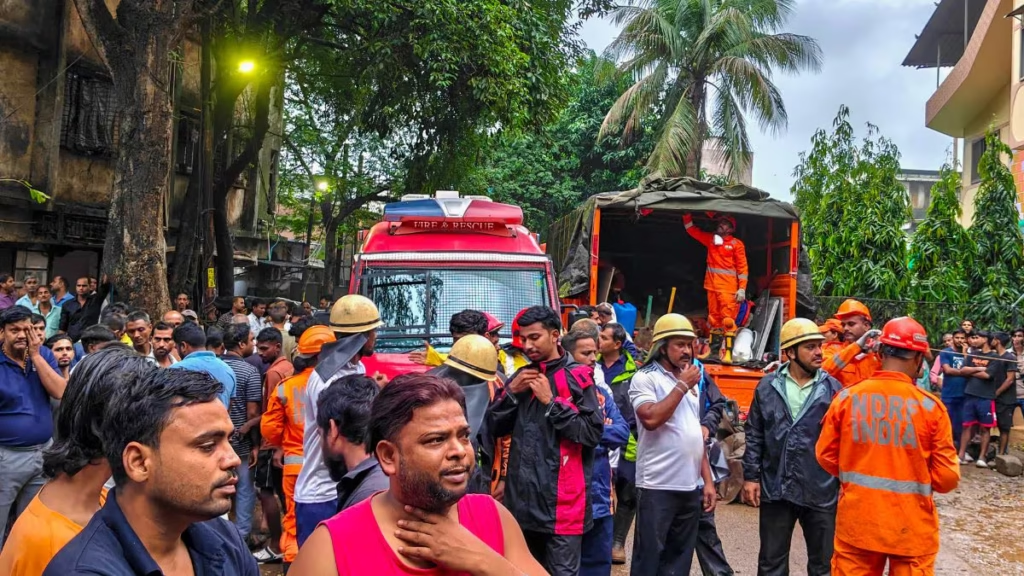
The rescue effort, which began immediately after the collapse, has grown into a massive multi-agency operation. Teams from the National Disaster Response Force (NDRF), the State Disaster Response Force (SDRF), the Thane Disaster Response Force, the local Bhiwandi Fire Brigade, and Bhoiwada Police Station have been working shoulder-to-shoulder through the night and into Friday morning.
The grim tally has steadily climbed. Initially, the Bhiwandi-Nizampur Municipal Corporation Fire Officer Vijay Jadhav reported one fatality and a young boy rescued alive and rushed to a nearby hospital. But as excavators and manual digging teams peeled back layers of concrete, more bodies were found. The NDRF confirmed that the death toll had reached nine by Friday mid-morning. The treacherous nature of the unstable debris even resulted in injuries to an NDRF Assistant Commandant who was actively leading rescue efforts on the mound.
A dog squad has been deployed to sniff out survivors, while heavy earth-moving machinery, including JCB excavators and four fire engines, crowd the narrow streets. However, rescue officials admitted that the sheer volume and weight of the rubble, combined with the delicate need to avoid crushing potential survivors, have severely slowed their progress.
The Bhiwandi collapse is a grim echo of a broader structural safety crisis plaguing Maharashtra. This disaster comes just weeks after a horrific structural failure on July 8 at the Moshi garbage depot in Pimpri Chinchwad, where nine people were crushed to death when a massive heap of waste collapsed onto an adjacent building.
As ambulances stand by with their engines running, the rescue operations in Bhiwandi show no signs of stopping. Authorities have vowed to continue digging until every last person feared trapped—including missing residents like Shamji Pal, Santosh Pandey, Miraj Sheikh, and several unidentified repair workers—is accounted for.
For now, the town of Bhiwandi holds its breath, hoping against hope for a miracle beneath the ruins of the Kohinoor Building.