The Supreme Court Steps In: Defending the Right to Peaceful Protest in the Shadow of the NEET Crackdown
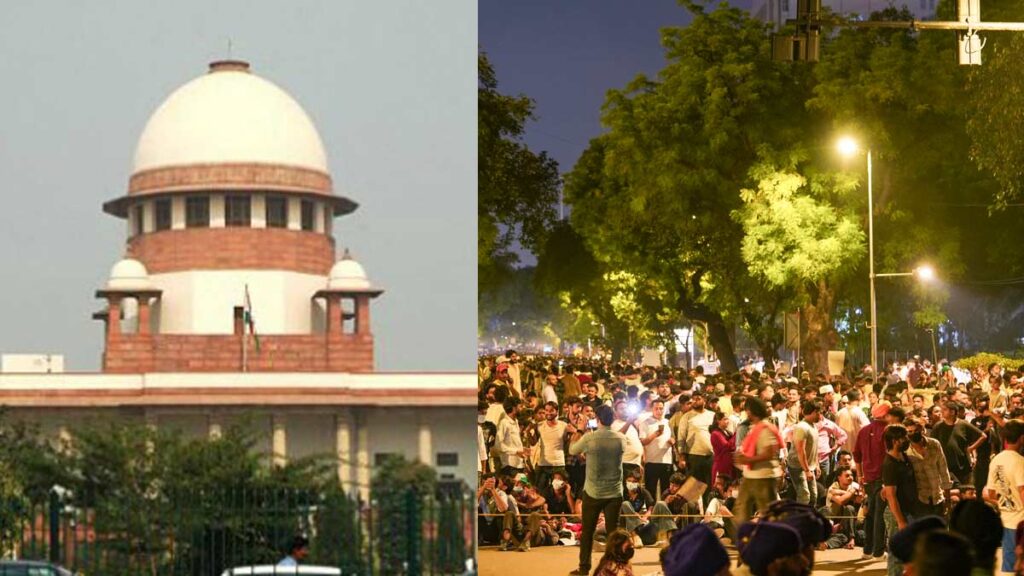
The Supreme Court Steps In: Defending the Right to Peaceful Protest in the Shadow of the NEET Crackdown
The escalating confrontation over the NEET-UG examination leaks has finally reached the highest echelons of Indian justice. On Monday, July 27, 2026, the Supreme Court of India intervened decisively in the ongoing crisis, underscoring a fundamental pillar of Indian democracy: the constitutional right to peaceful protest.
Following the controversial July 20 ‘Sansad Chalo’ march led by the Cockroach Janta Party (CJP), which culminated in violent clashes and allegations of severe police brutality, a bench led by Chief Justice of India (CJI) Surya Kant has taken up multiple petitions demanding accountability. The court’s initial observations have sent a clear message to law enforcement agencies across the country: mere agitation does not justify state violence.
The July 20 Crackdown: A Turning Point
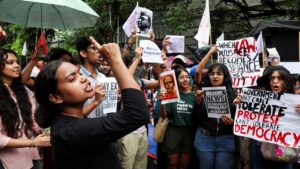
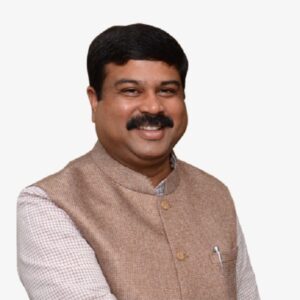
To understand the Supreme Court’s intervention, one must look at the events of July 20. Organized by the youth movement Cockroach Janta Party (CJP), the ‘Sansad Chalo’ (Walk to Parliament) march was the climax of a month-long sit-in at Jantar Mantar. The students were protesting the NEET-UG paper leaks and demanding the resignation of then-Education Minister Dharmendra Pradhan (who subsequently resigned on July 25).
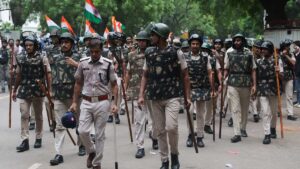
However, the march, which saw an estimated 50,000 to 100,000 young participants, was met with massive force. Delhi Police and Rapid Action Force (RAF) personnel deployed barricades, tear gas, and lathi charges to stop the students from reaching Parliament.
The aftermath of the march was grim. Widespread reports and viral videos surfaced showing uniformed and plainclothes personnel allegedly attacking unarmed students. The most shocking allegations involved the use of pellet guns—a weapon typically reserved for counter-insurgency operations. One 19-year-old student, Sahil Lochab, is currently at risk of losing vision in his right eye due to pellet injuries, and an Outlook journalist was also wounded. The CJP accused the police of “waging a war on youth and students.”
While the Delhi Police defended their actions, claiming the protesters became violent, pelted stones, and vandalized property, the disproportionate use of force sparked national outrage and a flurry of legal action.
The Supreme Court Intervenes
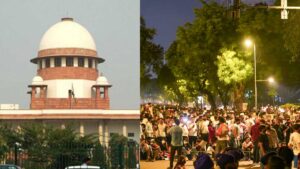
On July 27, responding to the urgency of the situation, CJI Surya Kant, alongside Justices Joymalya Bagchi and V. Mohana, directed that a batch of petitions alleging police excesses be listed for a comprehensive hearing on July 28.
During the mentioning hours, the CJI made significant oral observations that re-centered the debate on constitutional rights. “Right to peaceful, lawful protest is absolutely guaranteed under the Constitution,” CJI Surya Kant stated. “So long as it is a peaceful agitation, merely because there is agitation, there can’t be lathi charge… If there is excess committed, it should be independently examined.”
These words are a vital reaffirmation of democratic principles at a time when digital crackdowns and physical barricades are increasingly used to stifle dissent. The Chief Justice went further, identifying a systemic flaw in how protests are managed in India. He noted that the issue extends beyond Delhi, remarking, “There should be a protocol in place. There should be proper space and no restriction… Uniformity of protocol is needed.”
A Balanced Approach: Acknowledging Injured Police
Crucially, the Supreme Court demonstrated its intent to handle the matter with complete impartiality, acknowledging that the violence of July 20 had victims on both sides of the barricades.
During the session, lawyers representing the families of injured police officers approached the apex court, stating that policemen were “kicked and lynched” by violent mobs. The bench allowed their applications to be listed alongside the petitions from the students.
Justice Joymalya Bagchi emphasized this balance, noting, “Injuries suffered by police personnel and protesters deserve equal concern. The State may be called upon to explain why adequate equipment is not given to police to handle such situations.” The CJI echoed this sentiment, stating that the “life of every individual irrespective of who they are is important.”
The Legal and Political Stakes
The upcoming hearings, scheduled for July 28, carry immense weight. Senior advocate Gopal Sankaranarayanan, pushing for urgent listing, argued that the violence was not an isolated incident but an ongoing, nationwide problem where “police are using excessive force against children.” He poignantly reminded the bench, “The court stands between us and the police.”
The Supreme Court is now tasked with untangling a highly polarized narrative. On one side are thousands of students demanding justice for a compromised education system, armed with photographic evidence of police brutality and a soon-to-be-launched CJP website aimed at identifying abusive officers. On the other side is the state apparatus, arguing that they used necessary force to protect public order and parliament from an unruly mob.
The central government, already bruised by the forced resignation of Dharmendra Pradhan, will be watching closely. The outcome of these hearings could lead to independent investigations into the Delhi Police’s conduct, particularly regarding the alleged use of pellet guns by the CRPF (who are currently “verifying” the media reports).
Conclusion: A Test for Democracy
The Supreme Court’s willingness to independently examine the police excesses of July 20 is a beacon of hope for the student protesters. It signals that while the state possesses a monopoly on force, it does not possess a monopoly on truth or justice.
By demanding uniform police protocols for handling public demonstrations, the Supreme Court is not just addressing the NEET protests; it is attempting to safeguard the future of civic action in India. The hearings on July 28 will not only determine accountability for the violence at Jantar Mantar but will also redefine the boundaries of how a democratic state must engage with its dissenting youth. As the CJI made clear, a democracy must distinguish between a protest and a riot, and it cannot use the baton as its first response to the voice of its citizens.