Tamil Nadu Government Formation Drama Intensifies: Vijay Meets Governor Again, TVK May Explore Legal Route
Tamil Nadu Government Formation Drama Intensifies: Vijay Meets Governor Again, TVK May Explore Legal Route
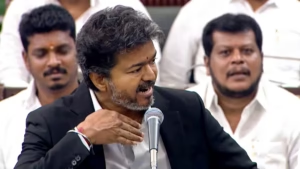
Tamil Nadu’s political landscape has entered a dramatic new phase after actor-turned-politician Vijay and his party, Tamilaga Vettri Kazhagam (TVK), emerged as the single largest force in the 2026 Assembly elections but fell short of a clear majority. With uncertainty looming over government formation, Vijay on Wednesday once again met Tamil Nadu Governor Rajendra Vishwanath Arlekar and reportedly renewed his claim to form the next government in the state.
The latest developments have sparked intense political speculation across Tamil Nadu, with discussions now centering on constitutional procedures, coalition negotiations, and even the possibility of legal intervention if TVK is denied the opportunity to form the government.
TVK scripted history in its debut Assembly election by winning 108 seats in the 234-member Tamil Nadu Assembly, ending decades of dominance by the two traditional Dravidian giants — the DMK and the AIADMK. However, the majority mark in the Assembly stands at 118 seats, leaving Vijay short of the numbers required to comfortably stake claim to power.
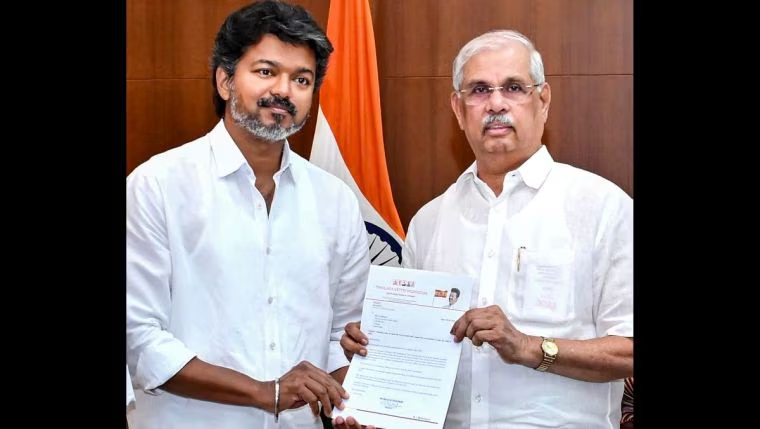
According to reports, Vijay met Governor Arlekar at Lok Bhavan in Chennai and sought time to gather support from smaller parties and independent MLAs. Sources indicate that the Governor has asked the TVK chief to provide documentary proof of majority support before any formal invitation to form the government is issued.
This has triggered a constitutional debate in political circles. Several legal and constitutional experts argue that as the single-largest party, TVK should be invited first to prove its majority on the floor of the Assembly rather than being asked to demonstrate support beforehand.
The issue has become even more politically sensitive because Vijay’s rise represents a historic shift in Tamil Nadu politics. For nearly six decades, the state’s political arena was dominated by the DMK and AIADMK. TVK’s stunning performance has disrupted that long-standing bipolar structure and introduced a new era of coalition politics in the southern state.
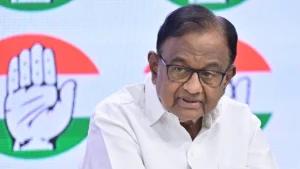
Amid the uncertainty, TVK is actively trying to build alliances with smaller regional parties and independents. Reports suggest the Congress party is open to supporting Vijay, though its numbers alone may not be enough to help TVK cross the majority mark. CPI(M) leaders have also confirmed receiving a proposal letter from Vijay seeking support.
At the same time, the AIADMK has publicly ruled out supporting TVK under any circumstances. The party’s decision is seen as a major setback for Vijay’s immediate government formation plans.
Interestingly, the DMK has adopted a softer tone. Party spokesperson Saravanan Annadurai stated that democratic convention demands that the single-largest party should be given the first opportunity to form the government. The remarks have surprised many political observers, especially considering the bitter electoral battle between the DMK and TVK.
Political analysts believe the coming days will be crucial for Vijay’s political future. If TVK successfully gathers outside support and submits the required numbers, the Governor could invite Vijay to take oath as Chief Minister and prove his majority through a floor test in the Assembly. However, if the numbers remain uncertain, the Governor may invite another alliance capable of demonstrating majority support.
There is also growing speculation that TVK may move the courts if it feels constitutional conventions are not being followed. Reports suggest the party’s legal team is examining previous Supreme Court judgments related to hung assemblies and the powers of Governors in inviting parties to form governments.
Another factor complicating the arithmetic is Vijay himself winning from two constituencies — Perambur and Tiruchirappalli East. Under election rules, he will eventually have to vacate one seat, slightly reducing the party’s tally. Additionally, the appointment of a Speaker could further affect voting numbers during a confidence motion.
Despite the political uncertainty, Vijay’s popularity remains exceptionally high among youth voters, urban middle-class groups, and first-time voters. Analysts say his campaign successfully combined anti-incumbency sentiment with promises of governance reforms, employment generation, industrial expansion, and technology-driven development.
Tamil Nadu’s business community is also closely watching the developments. The state remains one of India’s biggest manufacturing and industrial hubs, hosting major investments from global companies in sectors such as automobiles, electronics, semiconductors, and electric vehicles. Investors are hopeful that political stability will emerge quickly regardless of which party forms the government.
Meanwhile, social media has exploded with campaigns supporting Vijay’s claim to power. Hashtags demanding that TVK be invited first to form the government have been trending across platforms. Supporters argue that denying the single-largest party an opportunity would go against democratic norms and public mandate.
As Tamil Nadu waits for the Governor’s next move, the political atmosphere in the state remains tense and unpredictable. Whether Vijay manages to secure the numbers needed for government formation or the state heads toward another round of political negotiations—or even fresh elections—will likely become clear in the next few days.
For now, all eyes remain on Chennai, where one of the most dramatic post-election battles in recent Tamil Nadu history is unfolding.