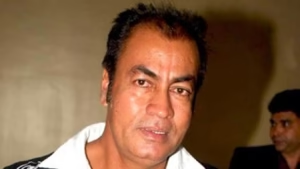
‘Breaking Bad’ Star and Disability Advocate R.J. Mitte Passes Away at 34: A Tragic Intersection of Mental Health and Cerebral Palsy

'Breaking Bad' Star and Disability Advocate R.J. Mitte Passes Away at 34: A Tragic Intersection of Mental Health and Cerebral Palsy
The entertainment industry and the global disability advocacy community have been plunged into deep mourning following the tragic and untimely passing of actor R.J. Mitte. Best known to audiences worldwide for his groundbreaking portrayal of Walter ‘Flynn’ White Jr. on the critically acclaimed television series Breaking Bad, Mitte passed away on Tuesday at his residence in Texas. He was 34 years old. While his representative has officially confirmed the heartbreaking news, authorities are currently investigating the circumstances surrounding his death, which is strongly suspected to be a suicide.
Mitte’s sudden death has sent shockwaves through Hollywood, prompting an outpouring of grief from fans, former co-stars, and disability rights activists. Beyond his undeniable talent on screen, Mitte was a beacon of hope and a relentless champion for inclusion. His passing has not only left a void in the acting world but has also ignited a crucial, urgent conversation about the severe mental health struggles that frequently accompany chronic physical conditions like cerebral palsy.
The Tragic Discovery and Ongoing Investigation According to preliminary reports and statements from local authorities, the actor was discovered unresponsive at his Texas home around 12:50 p.m. local time on Tuesday. Emergency responders arrived at the scene, but he was unfortunately pronounced dead. The Brownsville Police Department has taken charge of the case. In an official statement, a spokesperson for the department noted, “The cause and manner of death are still pending, as there is currently an ongoing investigation.”
While official autopsy and toxicology reports are awaited to provide conclusive answers, the suspicion of suicide has cast a heavy, somber shadow over his passing. It highlights a deeply unsettling reality about the silent, often invisible battles fought by those who appear to be thriving in the public eye.
Redefining Representation: The Legacy of Walter White Jr. R.J. Mitte’s entry into mainstream television was nothing short of revolutionary. Cast as the teenage son of the meth-cooking chemistry teacher Walter White in AMC’s Breaking Bad, Mitte brought an unprecedented level of authenticity to the screen. Like his character, Mitte lived with cerebral palsy. The show’s creator, Vince Gilligan, famously insisted on casting an actor who actually had the condition, a decision that proved instrumental in breaking down long-standing Hollywood stereotypes.
Through Walter White Jr., audiences witnessed the everyday realities of living with a motor disability—from utilizing crutches for mobility to experiencing speech impediments—without the character’s storyline being entirely consumed by pity or tragedy. Flynn was simply a teenager navigating a complex family dynamic, who happened to have cerebral palsy. This normalized portrayal was a watershed moment for disability representation in media.
Beyond his defining role in Breaking Bad, Mitte continued to build a diverse and impressive acting portfolio. He showcased his versatility in various television shows and films, including Switched at Birth, Robot Chicken, the suspenseful thriller The Oak Room, and the science fiction film The Recall.
A Lifelong Champion for Disability Inclusion Mitte’s personal journey with cerebral palsy began very early; he was diagnosed with the condition at just three years of age. Instead of letting the neurological disorder limit his aspirations, he harnessed his platform to become one of the most prominent and vocal advocates for disability inclusion in the entertainment sector.
He tirelessly campaigned for equal opportunities for disabled actors, serving as a prominent spokesperson for the Screen Actors Guild (SAG) specifically focusing on actors with disabilities. Furthermore, his philanthropic efforts were extensive. He served as a celebrity ambassador for United Cerebral Palsy and Shriners Children’s Hospital, utilizing his fame to raise awareness, funds, and spirits. He frequently spoke at events, offering encouragement to children and families navigating the same physical hurdles he had faced his entire life.
The Hidden Battle: Cerebral Palsy and Mental Health To fully understand the gravity of Mitte’s suspected suicide, one must examine the complex intersection of cerebral palsy and mental well-being. Cerebral palsy is a group of permanent, non-progressive neurological disorders that severely affect body movement, muscle tone, posture, and physical coordination. While there is no known cure, various therapies and management strategies can improve a patient’s daily function and independence.
However, the medical community has increasingly recognized that the toll of cerebral palsy extends far beyond physical limitations. Individuals living with CP face a significantly elevated risk of developing severe mental health conditions. Anxiety and depression are the most frequently reported psychological challenges among both children and adults with the condition. Furthermore, they face higher rates of mood affective disorders, attention-deficit/hyperactivity disorder (ADHD), and severe behavioral challenges.
The mental health struggles experienced by people with cerebral palsy are rarely isolated issues; they stem from a grueling combination of physical, neurological, and social elements. Medical professionals and psychologists point to several major contributory factors that make daily life an immense psychological burden:
First, chronic pain is a constant companion for many. The relentless musculoskeletal pain, muscle spasticity, and severe joint stress are among the strongest predictors of poor mental well-being and clinical depression.
Second, there is the issue of physical and energy fatigue. Managing significant motor impairments requires a phenomenally high daily energy expenditure. Simple tasks that able-bodied individuals take for granted require intense concentration and effort, leading to chronic physical and cognitive exhaustion.
Third, co-occurring medical conditions frequently overlap with CP, compounding the patient’s distress. These often include severe sleep disturbances, epilepsy, sensory impairments, and sometimes intellectual or communication difficulties.
Finally, the social and environmental pressures are immense. Despite advocates like Mitte pushing for change, society remains challenging for disabled individuals. Limitations in social participation, the lingering fear of bullying or stigmatization, and intense anxieties regarding long-term independence and employment frequently contribute to deep emotional distress and a profound sense of isolation.
A Somber Farewell The loss of R.J. Mitte at the young age of 34 is a monumental tragedy. It is a stark, heartbreaking reminder that physical disabilities are often accompanied by invisible psychological torment. As authorities continue to investigate the exact circumstances of his death, his life’s work remains an enduring testament to the power of representation.
Mitte leaves behind a legacy of shattered glass ceilings and a plea for a more inclusive, empathetic world. His passing serves as a desperate call to action for better mental health resources, not just for the general public, but specifically tailored to the unique, grueling realities faced by those living with chronic physical disabilities like cerebral palsy. He will be deeply missed, but the doors he opened for disabled actors and the awareness he brought to millions will never be forgotten.