Corporate Shocker: Tata Sons Chairman N. Chandrasekaran Resigns Ahead of AGM; Tata Group Stocks Slip
Corporate Shocker: Tata Sons Chairman N. Chandrasekaran Resigns Ahead of AGM; Tata Group Stocks Slip
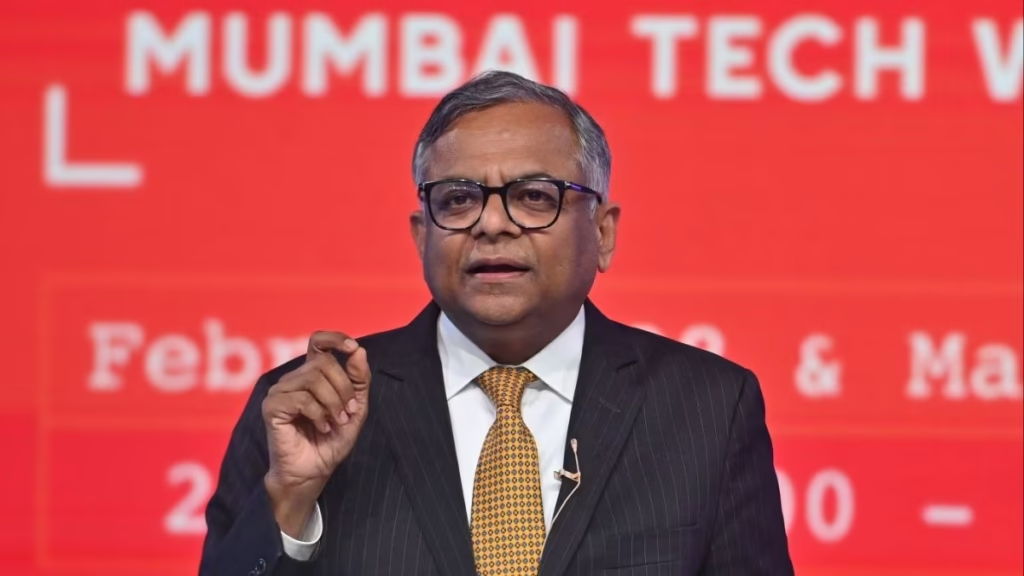
Mumbai / New Delhi (August 12, 2026): In a massive development sending shockwaves across India’s corporate landscape, Natarajan Chandrasekaran has decided to step down as the Chairman of Tata Sons, the flagship holding company of the $150-billion Tata Group. The 63-year-old corporate veteran, who has steered the conglomerate for nearly a decade, will not seek reappointment as a director at the upcoming Annual General Meeting (AGM) scheduled for August 18, 2026.
The unexpected exit of “Chandra,” as he is affectionately known in business circles, marks an unplanned leadership transition at India’s most prestigious business house. The news triggered immediate turbulence on Dalal Street, wiping out tens of thousands of crores in market capitalization across listed Tata entities as investors reacted to the prospect of leadership uncertainty.
Why Did N. Chandrasekaran Step Down?
While Chandrasekaran’s official tenure was set to run until February 2027, internal friction between Tata Sons management and Tata Trusts—the philanthropic umbrella that holds a controlling 66% stake in Tata Sons—appears to have accelerated his departure.
According to industry sources, differences had been brewing between Chandrasekaran and Noel Tata, who assumed leadership of Tata Trusts following the passing of Ratan Tata. The core disagreements reportedly centered on two major issues:
- Capital Allocation and New Business Performance: Noel Tata and members of the Trusts expressed growing reservations regarding the heavy capital expenditure and delayed profitability of several new ventures championed by Chandrasekaran, including the super-app Tata Neu, semiconductor manufacturing, and electric vehicle (EV) battery gigafactories.
- Retirement Policy and Tenure Extensions: Under Tata Group guidelines, executive leadership roles carry a strict retirement age of 65. Although Tata Trusts had initially approved a third five-year extension for Chandrasekaran in late 2025, Noel Tata later pushed to restrict the extension to two years so that Chandrasekaran would retire at 65. In February 2026, the Tata Sons board deferred a final decision on the extension, creating an uncomfortable standoff.
The situation became further complicated due to an ongoing legal stay imposed by the Maharashtra Charity Commissioner on certain administrative actions of the Sir Ratan Tata Trust (SRTT). Facing an uncertain and potentially contentious vote at the August 18 AGM, Chandrasekaran chose to step down gracefully to avoid a public governance dispute.
Dalal Street Reacts: ₹39,000 Crore Wipeout in Market Cap
The announcement of Chandrasekaran’s resignation sent shockwaves through the financial markets. Investors rushed to trim exposure to Tata Group stocks amid concerns over top-level stability and potential delays in major ongoing projects.
The combined market capitalization of listed Tata Group companies plummeted by nearly ₹39,000 crore in a single trading session:
- Tata Consultancy Services (TCS): The group’s IT flagship and cash cow bore the brunt of the sell-off, with its stock declining by 3.62%.
- Tata Motors: Shares dropped 1.65% due to investor anxiety over leadership continuity in the EV and Jaguar Land Rover (JLR) transition strategies.
- Tejas Networks: The telecom gear maker saw its shares fall 2.17%.
- Other Group Entities: Tata Power, Tata Steel, Indian Hotels Company Limited (IHCL), Tata Communications, and Tata Elxsi all ended significantly in the red.
A Historic Legacy: The Man Who Transformed Tata
N. Chandrasekaran’s journey with the Tata Group is widely regarded as one of the most remarkable stories in Indian corporate history.
Joining TCS as a software intern in 1987, Chandrasekaran rose through the ranks to become CEO in 2009. Under his leadership, TCS transformed into a global IT superpower, generating massive cash flows that sustained the broader group through challenging times.
In January 2017, following the high-profile and tumultuous exit of Cyrus Mistry, Chandrasekaran was appointed Chairman of Tata Sons—becoming the first non-Parsi, professional manager to head the group.
Key Achievements During His Tenure:
- The Air India Acquisition: Spearheaded the historic return of national carrier Air India to the Tata fold, initiating a multi-billion-dollar fleet modernization and consolidation drive.
- Future-Proofing the Business: Pushed aggressive bets into semiconductors, green energy, EV supply chains, and digital ecosystems to position the group for the next decade of growth.
- Debt Reduction and Simplification: Streamlined the complex web of cross-holdings across group companies, significantly reduced debt at Tata Steel and Tata Motors, and enforced strict fiscal discipline.
What Lies Ahead for the Tata Group?
Chandrasekaran’s sudden departure comes at a critical juncture. The Tata Group is currently committed to massive capital-intensive greenfield investments, including multi-billion-dollar semiconductor fabs in Gujarat and Assam, an EV battery gigafactory in the UK, and the ongoing operational overhaul of Air India.
With the August 18 AGM approaching, the immediate focus shifts to Tata Trusts and the Tata Sons board to announce an interim governance arrangement and outline a succession roadmap. Market watchers will be closely evaluating who will step into the role of Chairman to navigate the conglomerate through its next phase of expansion while maintaining harmony with its principal shareholder, Tata Trusts.