Ghaziabad Police Gun Down Rape Accused in Late-Night Encounter; Second Such Incident Sparks Renewed Debate on UP’s Law Enforcement Tactics
Ghaziabad Police Gun Down Rape Accused in Late-Night Encounter; Second Such Incident Sparks Renewed Debate on UP’s Law Enforcement Tactics
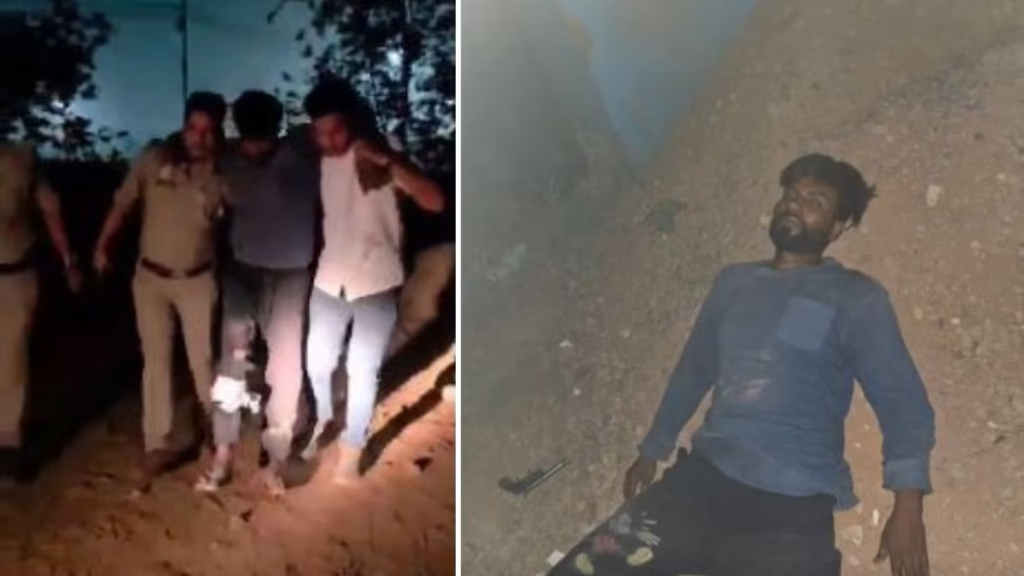
GHAZIABAD — In a dramatic escalation of Uttar Pradesh’s aggressive policing strategy, a 28-year-old man accused of the horrific rape of a 13-year-old girl was shot and neutralized during a late-night police encounter on the outskirts of Ghaziabad. The incident, which unfolded in the early hours of Monday, marks yet another controversial chapter in the state’s stringent, often lethal, crackdown on alleged perpetrators of heinous crimes against women and minors.
The shootout comes on the heels of mounting public outrage and intense media scrutiny following a string of high-profile crimes in the National Capital Region (NCR). As the state government doubles down on its zero-tolerance policy towards criminals, the encounter has simultaneously drawn praise from weary citizens and sharp criticism from human rights advocates questioning the judicial bypass of these operations.
The Crime That Shocked the City
The grim sequence of events began late Friday evening when a 13-year-old girl, a resident of a densely populated neighborhood in Ghaziabad, was reported missing by her family. According to the First Information Report (FIR) filed at the local police station, the minor had stepped out to purchase groceries from a nearby kiosk but failed to return. After hours of frantic searching, local residents discovered the girl in a semi-conscious state in a desolate, under-construction building in the vicinity.
Medical examinations swiftly confirmed brutal sexual assault, and the victim was immediately rushed to a specialized medical facility where she is currently undergoing treatment and psychological counseling. The sheer brutality of the crime sent shockwaves through the community, leading to spontaneous protests outside the local police station, with massive crowds demanding immediate and uncompromising justice.
Acting on CCTV footage retrieved from the area and eyewitness testimonies, the Ghaziabad Police quickly identified the primary suspect as a local laborer with a prior history of petty crimes. A massive manhunt was launched, with multiple police teams and the Special Task Force (STF) deployed to track down the absconding accused.
The Midnight Encounter
The pursuit culminated in a violent confrontation late Sunday night. According to the official police briefing provided by the Deputy Commissioner of Police (City), law enforcement received actionable intelligence from a network of informants indicating that the suspect was hiding in a deserted industrial warehouse near the Delhi-Meerut Expressway.
A joint team comprising the local precinct officers and the Crime Branch quickly cordoned off the perimeter. Police officials claim that as the raiding party moved in to apprehend the suspect, they were met with unprovoked gunfire.
“The suspect was repeatedly warned and asked to surrender peacefully. However, instead of complying, he opened fire on the police personnel using a country-made pistol, seemingly in a desperate bid to break the cordon and escape,” the DCP stated during the press conference. “Acting in strict self-defense, our teams retaliated. During the ensuing crossfire, the accused sustained severe bullet injuries.”
The injured suspect was immediately transported to the nearest government district hospital. However, he succumbed to his injuries en route and was declared dead on arrival by the attending medical officers. Two police constables reportedly sustained minor injuries during the firefight and are currently in stable condition. Forensic teams have since secured the encounter site, recovering the illegal firearm, spent cartridges, and a stolen motorcycle allegedly used by the accused to flee the scene of the crime.
A Pattern of Swift, Lethal Justice
This incident is not an isolated event but rather fits into a broader, highly publicized pattern of law enforcement in Uttar Pradesh under the current administration. Known colloquially as ‘Operation Langda’ or swift encounter justice, the state police have frequently resorted to armed confrontations when dealing with individuals accused of severe offenses, particularly crimes against women, children, and organized syndicate operations.
Just weeks prior, another high-profile case in the Ghaziabad-Noida belt culminated in a similar police encounter, where an accused involved in the assault of a minor was shot and subsequently hospitalized. The UP government has consistently defended these actions, framing them as a necessary deterrent to restore public confidence and maintain law and order in a state historically plagued by high crime rates. Senior political figures and cabinet ministers have often championed these encounters, arguing that criminals who brazenly attack the vulnerable forfeit their right to leniency.
Public Approval and Human Rights Concerns
The public reaction to the latest encounter has been starkly polarized. For the victim’s traumatized family and the local community, the swift neutralization of the accused provided a sense of immediate, visceral retribution. In neighborhoods gripped by fear, the police are frequently hailed as heroes for dispensing rapid justice, sidestepping the notoriously sluggish judicial process that often takes years to convict perpetrators.
However, legal experts, civil society organizations, and human rights watchdogs view this growing trend with deep alarm. Critics argue that the frequent resort to extrajudicial killings fundamentally undermines the rule of law and the constitutional guarantee of a fair trial. The National Human Rights Commission (NHRC) has previously issued multiple guidelines mandating rigorous, independent magisterial inquiries into all police encounters resulting in death, emphasizing that the police cannot act as judge, jury, and executioner.
Advocates warn that the normalization of ‘encounter justice’ sets a dangerous precedent, potentially leading to the targeting of marginalized communities or the execution of innocent individuals framed by systemic biases. They stress that true justice requires robust, transparent investigations and expedited judicial trials, rather than state-sanctioned violence.
The Road Ahead
As the mandatory magisterial probe into the encounter begins, the Ghaziabad Police are consolidating their files and preparing the detailed forensic and ballistic reports required by law. The state government remains steadfast in its defense of the police force, reiterating its uncompromising stance on public safety.
Meanwhile, the 13-year-old survivor continues her battle for recovery in the hospital, serving as a tragic reminder of the deep-rooted societal vulnerabilities that persistently endanger children. Whether this latest encounter will act as a genuine deterrent or merely fuel the ongoing debate over police vigilantism remains to be seen. What is undeniable, however, is that the streets of Uttar Pradesh are witnessing a fundamental, and highly contentious, shift in the execution of criminal justice.