India and New Zealand Move Closer to Free Trade Deal: What It Means for Both Economies
India and New Zealand Move Closer to Free Trade Deal: What It Means for Both Economies
New Delhi / Auckland – 6 November 2025:
After a ten-year lull, negotiation efforts between India and New Zealand on a free trade agreement have gained renewed momentum. The fourth round of talks, held 3–7 November in Auckland, focuses on key areas such as trade in goods, trade in services and rules of origin, indicating that both nations are seriously working towards “early conclusion” of the FTA.
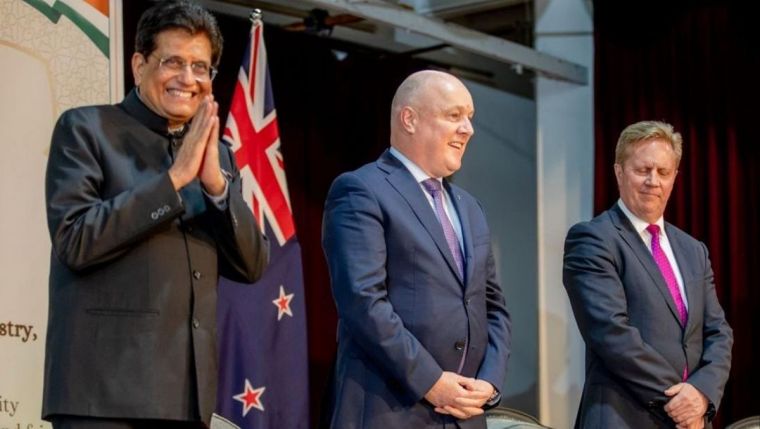
India’s Commerce & Industry Minister Piyush Goyal described the pact as a “win-win” opportunity, emphasising that the partnership must respect each country’s sensitivities and scale.. New Zealand’s Prime Minister Christopher Luxon underscored the significance of people-to-people ties and labour mobility — signalling that the FTA will go beyond mere tariff reductions.
Why This FTA Matters
- Trade revival after a decade-long hiatus
Negotiations originally began around 2010 but stalled in 2015. The current round marks the first major sustained push in years to complete the deal - Growth potential
Bilateral goods and services trade between India and New Zealand is still modest — but with the right framework in place, officials suggest there’s significant upside. - Sectoral opportunities
The FTA’s agenda covers a broad range: agriculture (particularly for NZ), textiles, pharmaceuticals, services, logistics, and labour mobility. For instance, India exports textiles, pharma, machinery; New Zealand exports agricultural goods like wool, timber, apples. - Rules of Origin & services included
Beyond tariffs, the negotiations are concentrating on technical issues such as rules of origin (which determine how much domestic content qualifies for preferential tariffs) and services trade — indicating a modern, comprehensive pact.
What’s New & What’s At Stake
- The fourth round of talks is seen as a breakthrough: India is sending one of its largest delegations ever to New Zealand for the purpose, signalling seriousness
- New Zealand emphasises labour mobility: Luxon explicitly connected the FTA with making visa and migration processes easier for Indian professionals.
- Business communities in both countries are being urged to prepare: The chair of the India-New Zealand Business Council in NZ said firms should begin strategic partnerships ahead of the expected deal.
- While sectors like agriculture are important for New Zealand, India is looking to incorporate forward-looking aspects: human development, services, supply-chain resilience.
Challenges Ahead
- Agricultural sensitivities: Past negotiations stalled partly over dairy and agriculture tariffs. New Zealand’s farm industry has traditionally pressed for favourable access.
- Scale difference: India is a large economy; New Zealand comparatively small. Minister Goyal noted one size/framework may not fit both — the agreement must reflect each country’s scale and context.
- Timetable: While optimism is high, a definitive timeline has not been firmly established. Some reports suggest conclusion “this week” or “soon” but no exact date.
What It Means for India & New Zealand
- For India: Improved access into a developed-market economy, potential growth in exports (especially in textiles, pharma, engineering goods), services exports (education, IT, healthcare), and greater mobility for skilled professionals.
- For New Zealand: Enhanced access to India’s market of 1.4 billion people, boosting exports of agriculture and forestry goods, an opportunity to align with India’s growth story and diversify trade beyond traditional partners.
- For businesses: Both Indian and New Zealand companies should start preparing: assess supply chains, explore partnerships, analyse regulatory changes, anticipate tariff reductions. The time to move is now.
- For labour & education: With the emphasis on people-to-people ties, Indian students in NZ and Kiwi participation in the Indian market/service sectors may increase.