Echoes of Change in UP: How the Owaisi-Azad ‘Samajik Parivartan Morcha’ Gives Voice to the Forgotten
Echoes of Change in UP: How the Owaisi-Azad ‘Samajik Parivartan Morcha’ Gives Voice to the Forgotten
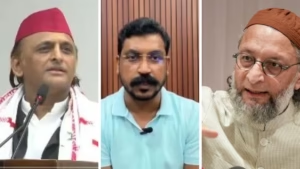
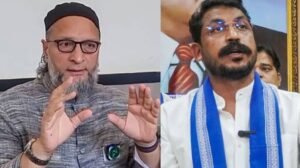
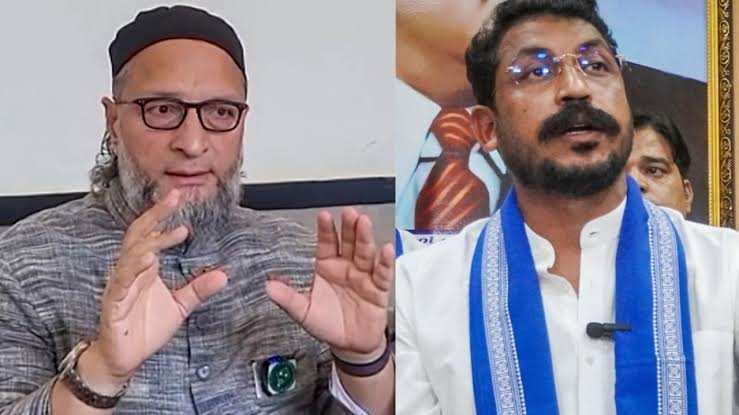
On a crisp Thursday morning in Lucknow, a profound shift in Uttar Pradesh’s political landscape was quietly set in motion. Away from the high-decibel corridors of entrenched power, two distinct but resonant voices came together, promising to rewrite a narrative that has defined the state’s elections for decades. All India Majlis-e-Ittehadul Muslimeen (AIMIM) president Asaduddin Owaisi and Azad Samaj Party (Kanshi Ram) chief Chandrashekhar Azad stood shoulder to shoulder, unveiling the ‘Samajik Parivartan Morcha’—a united front forged not just for political gain, but as a rallying cry for the marginalized.
At the heart of this new coalition is a deeply human story. For generations, the Dalits and Muslims of Uttar Pradesh have been heavily courted during election seasons, only to find themselves relegated to the shadows once the ballots are cast. They have been treated as monoliths—reliable vote banks expected to fall in line behind the grand promises of major political parties. But on the ground, the reality is starkly different. It is a reality painted with the quiet desperation of a father unable to find steady work, the anxiety of a mother watching her educated son sit idle, and the frustration of communities struggling for basic dignity in a rapidly changing society.
Chandrashekhar Azad, the fiery youth icon who recently cemented his political arrival with a stunning victory from the Nagina Lok Sabha constituency in 2024, did not mince words. Speaking to the press, he bypassed the usual political rhetoric to strike at the raw nerves of everyday survival. He spoke of the lingering, invisible scars of demonetization that continue to stifle small rural economies. More pressingly, he pointed to the devastating decline in government jobs. “We have young, bright minds from Dalit and backward communities who have worked tirelessly to earn their degrees,” Azad remarked, his voice carrying the weight of thousands of unheard youth. “Yet, they are denied opportunities. They are left with paper degrees and no future. The government will have to answer to the people for these failures.”
This is where the Samajik Parivartan Morcha—literally translating to the ‘Front for Social Change’—finds its true pulse. Political pundits are already rushing to label it the “third front,” a convenient box to place them in opposition to the BJP-led NDA and the Samajwadi Party-Congress bloc. However, Azad quickly dismantled this clinical definition. To him, and to the millions looking for an alternative, this is not merely a third option on a ballot sheet; it is the first front for those who demand social equity and institutional justice.
Historically, the dream of uniting Dalits and Muslims in Uttar Pradesh is not entirely new, but it has rarely been sustained. Decades ago, the early movements of the Bahujan Samaj Party under Kanshi Ram sought to weave together a coalition of the oppressed, recognizing that true power lay in the unity of those left out of the traditional hierarchies. Over the years, however, the politics of appeasement and the allure of mainstream assimilation fractured this unity. The current leadership vacuum, coupled with growing disillusionment with established parties, has created fertile ground for a resurgence of this alliance. Azad, who proudly carries Kanshi Ram’s legacy in the very name of his party, and Owaisi, who advocates fiercely for constitutional rights, are attempting to rekindle a historic solidarity. Their partnership is built on the premise that both communities share a common experience of systemic exclusion—whether it is facing housing discrimination, disproportionate systemic hurdles, or battling the stigma that often accompanies their identities.
The electoral mathematics behind this emotional appeal is staggering and possesses the potential to completely upend UP’s political calculus ahead of the 2027 Assembly elections. Together, Muslims and Scheduled Castes make up nearly 40 per cent of the state’s population—approximately 19 per cent and 21 per cent, respectively. In a politically hyper-competitive state where margins of victory are often razor-thin, a united bloc of 40 per cent is not just a swing factor; it is a kingmaker.
For Asaduddin Owaisi, this alliance is a crucial opportunity for redemption and expansion. Despite his immense popularity as a charismatic and articulate voice for minority rights, Owaisi’s AIMIM struggled to make a tangible dent in the 2022 UP Assembly polls, securing less than 0.5 per cent of the vote across the 95 seats it contested. Yet, his influence in western Uttar Pradesh and the Rohilkhand region remains undeniable. By aligning with Azad, whose grassroots mobilization through the Bhim Army has created a deeply loyal Dalit support base, Owaisi is bridging the gap between fiery parliamentary rhetoric and fierce street-level activism.
The tremors of this alliance will be felt most acutely in the headquarters of the state’s traditional heavyweights. For the ruling Bharatiya Janata Party, which has built a formidable electoral machine in UP, the consolidation of a Dalit-Muslim bloc presents a massive roadblock to their ambitions of returning to power. Meanwhile, the Samajwadi Party, led by Akhilesh Yadav, finds itself facing an existential threat to its carefully crafted PDA (Pichda, Dalit, Alpsankhyak) formula. If the Samajik Parivartan Morcha successfully convinces minorities and Dalits that their futures are better served by leaders from within their own ranks, the SP and Congress could see their traditional support bases severely fractured.
But beyond the cold arithmetic of seat-sharing and vote percentages, the emergence of the Samajik Parivartan Morcha is a testament to the evolving aspirations of India’s electorate. Voters are no longer satisfied with being passive participants in the democratic process. The youth, in particular, are asking tough, uncompromising questions. They want to know why their schools are underfunded, why their job applications go unanswered, and why their identities are only validated when an election is around the corner.
As the political machinery of Uttar Pradesh gears up for 2027, the road ahead for Owaisi and Azad will be fraught with challenges. Bringing together two distinct communities, each with its own complex socio-economic realities, requires more than just shared grievances; it requires a cohesive, actionable vision for governance. They will have to prove that they are not just splitting votes, but acting as viable administrators capable of delivering the change they promise.
Ultimately, the launch of the Samajik Parivartan Morcha is a defining moment for Indian democracy. It is a loud, unapologetic declaration that the marginalized will no longer wait for a seat at the table—they are building their own. Whether they succeed in capturing power or not, Owaisi and Azad have already succeeded in changing the conversation, ensuring that the 2027 elections will not just be fought on the grounds of legacy, but on the pressing, undeniable realities of jobs, dignity, and survival.