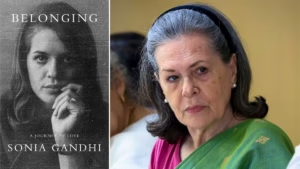
“No Real Contact”: Sonia Gandhi Breaks Silence on PM Modi, 2004 PM Post, and Trauma in Revealing New Memoir ‘Belonging’
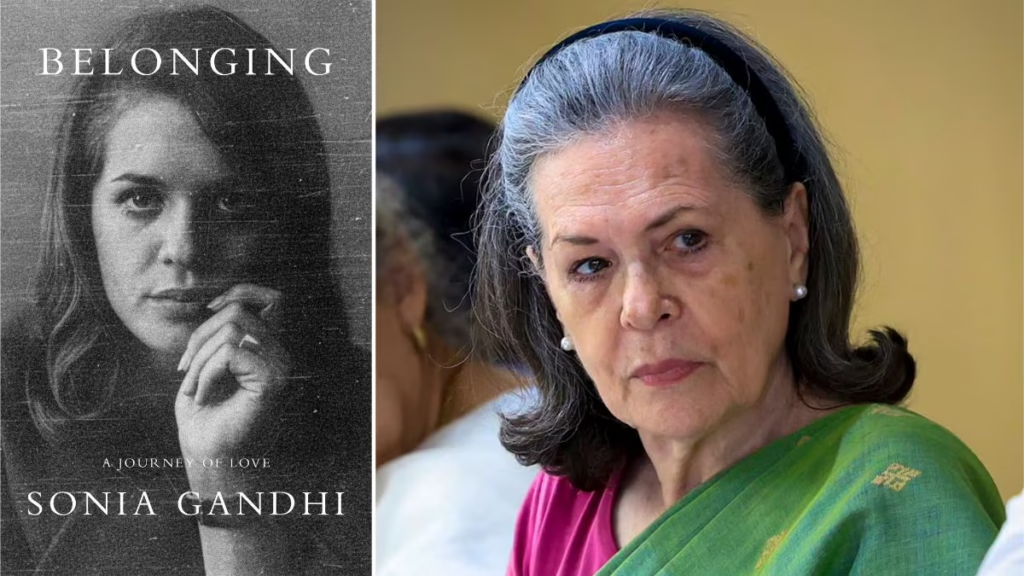
"No Real Contact": Sonia Gandhi Breaks Silence on PM Modi, 2004 PM Post, and Trauma in Revealing New Memoir 'Belonging'
NEW DELHI — In a major political and literary moment, Sonia Gandhi, the longest-serving president in the history of the Indian National Congress, is set to release her highly anticipated memoir, Belonging: A Journey of Love. Ahead of the book’s global launch, the veteran political leader offered a rare, extensive, and deeply candid interview to The Hindu, pulling back the curtain on her closely guarded personal life, her decades at the helm of Indian politics, and her relationship with her fiercest political rival, Prime Minister Narendra Modi.
The memoir and the accompanying revelations offer an unprecedented look into the mind of a woman who shaped India’s destiny for over two decades. From the agonizing decision to turn down the Prime Minister’s post in 2004 to her scathing critique of the current Bharatiya Janata Party (BJP) regime, Gandhi’s latest disclosures are already sending ripples through the national political landscape.
The Equation with PM Modi: “No Real Contact”
One of the most striking takeaways from her recent interactions is her stark assessment of her relationship with Prime Minister Narendra Modi. When questioned about her personal equation and interactions with the PM, Gandhi delivered a crisp, unambiguous response: there is “no real contact with him.”
Despite both leaders being the central pillars of their respective political alliances for the past decade, Gandhi revealed that their interactions are strictly confined to formal, distant greetings. When they cross paths at public events, state functions, or within the halls of Parliament, they acknowledge each other with a customary greeting—but the engagement ends there. There is no back-channel communication, no personal rapport, and no political dialogue. This candid admission underscores the deep, unbridgeable ideological and personal chasm that exists between the leadership of India’s two largest political forces.
A Scathing Critique of the Modi Government
Sonia Gandhi did not hold back in her assessment of the Modi government’s rule from 2014 to 2026. In her interview, she articulated a profound concern for the state of the nation, accusing the current administration of inflicting severe damage on the “social fabric of our country” and systematically eroding independent democratic institutions.
Gandhi cautioned that even after the current government eventually exits power, the road to recovery will be arduous. Restoring the neutrality, independence, and constitutional integrity of India’s institutional framework, she noted, will require immense time, resilience, and a collective effort from across the political spectrum. Nevertheless, she expressed an enduring faith in the strong, democratic roots of India, believing that the nation will ultimately course-correct.
“We Have Nothing to Learn from the RSS”
Addressing a frequently debated question in political circles—whether the beleaguered Congress party needs to adopt the organizational strategies of the Rashtriya Swayamsevak Sangh (RSS) or the BJP’s cadre-building mechanisms—Gandhi was fiercely dismissive.
She categorically stated that the Congress has absolutely nothing to learn from the RSS. Highlighting the fundamental ideological differences, she remarked that Prime Minister Modi comes from a “completely different ideological world.” Gandhi firmly defended the Congress’s internal democratic processes, pointing out that leaders within her party emerge through distinct, democratic pathways. She cited former Prime Minister Dr. Manmohan Singh and current Congress President Mallikarjun Kharge as prime examples of leaders who reached the absolute pinnacle of Indian politics through merit, hard work, and the party’s democratic ethos, entirely devoid of an RSS-style background.
The Defining Moment: Why She Walked Away in 2004
For nearly two decades, political historians and the Indian public have speculated about the dramatic days of May 2004, when the Congress-led United Progressive Alliance (UPA) ousted the Atal Bihari Vajpayee government, and Sonia Gandhi unexpectedly declined the Prime Ministership. In Belonging: A Journey of Love, she finally details the emotional turbulence behind that historic choice.
The book reveals that the decision was not a last-minute political maneuver but a deeply personal choice discussed with her children, Rahul and Priyanka, months before the election results. Both children were vehemently opposed to her taking the top job. The trauma of the brutal assassinations of their grandmother, Indira Gandhi, and their father, Rajiv Gandhi, loomed large. They feared that the Prime Minister’s post would place their mother in “heightened danger.”
Gandhi poignantly recounts the intense night when senior Congress leaders and coalition allies converged at her residence, exerting immense pressure on her to accept the mandate. Overwhelmed, she almost caved, uttering a hesitant “okay.” However, a distressed Rahul and Priyanka entered her room, urging her to stand her ground. “Do not succumb to pressure. Do what you had decided,” they told her, promising to help her weather the political fallout. Listening to her “inner voice,” she stepped aside the next day, famously declaring that power had never been her aim, and nominated Dr. Manmohan Singh for the role.
A Journey of Love, Loss, and Trauma
While Belonging is inextricably linked to politics, Gandhi insists it is not a political manifesto. At its core, it is a human story. It chronicles the journey of a 19-year-old girl from a small Italian town who falls in love with an Indian student, moves to a foreign land, and slowly, profoundly, makes India her own.
The memoir does not shy away from the darkest chapters of her life. Gandhi shares a harrowing account of October 31, 1984—the day her mother-in-law, Prime Minister Indira Gandhi, was assassinated. She describes the agonizing ambulance ride, cradling a blood-soaked Indira, realizing mid-journey that she was already gone. The subsequent years, she writes, were marked by severe trauma and crippling depression, a period where she lived “like a ghost.”
Conclusion
Sonia Gandhi’s Belonging: A Journey of Love promises to be a seminal piece of literature, offering a definitive account of modern Indian history through the eyes of its most pivotal, yet fiercely private, matriarch. By opening up about her non-existent equation with PM Modi, her unwavering ideological stance, and the profound grief that shaped her destiny, Gandhi has ensured that her narrative will dominate the political and literary conversation for months to come.