Delhi Chokes After Diwali as AQI Crosses 400, Triggering a BJP-AAP-Congress Blame Game
Delhi Chokes After Diwali as AQI Crosses 400, Triggering a BJP-AAP-Congress Blame Game
A thick blanket of smog has settled over the capital, with air quality in the “severe” range at several locations. Residents are struggling to breathe while political parties trade accusations.
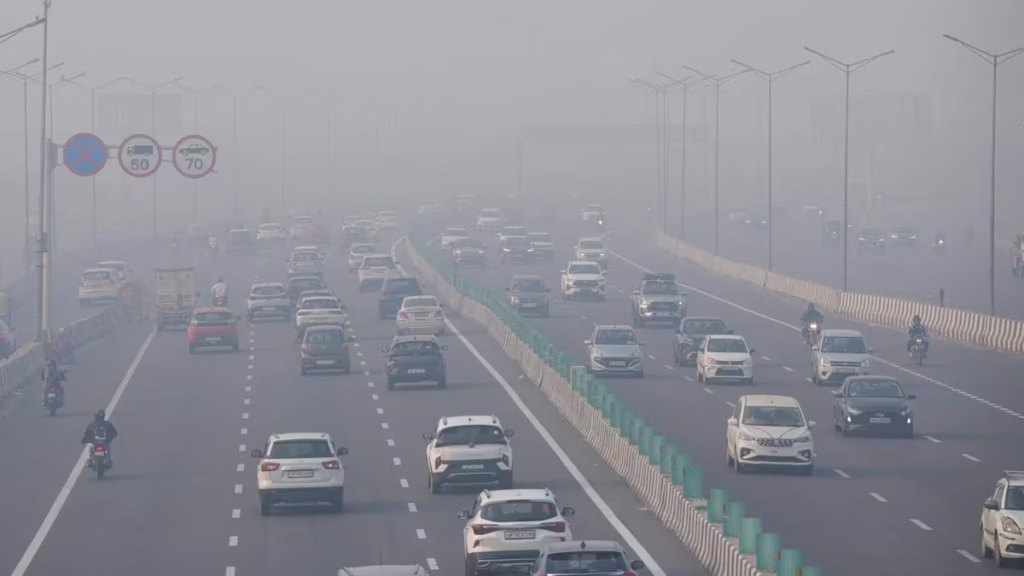
Delhi’s air quality fell sharply on Monday, 9 November, the day after Diwali. The Air Quality Index (AQI) crossed 400 at several locations, a level classed as “severe”. A dense layer of smog cut visibility across the city, as photographs of vehicles creeping past Akshardham Temple showed.
Conditions had already worsened on Sunday
The slide began well before Monday’s reading. On Sunday, 20 monitoring stations had already slipped into the “severe” category, and Delhi’s overall AQI stood at 371 at 10 pm. Monday’s spike therefore followed a night of steadily rising pollution.
Fireworks were reported in several parts of the capital on Sunday evening despite restrictions on firecrackers. That raises fresh questions about how well the curbs were enforced and monitored.
BJP alleges a “conspiracy” over stubble burning
The political row began with BJP MP Praveen Khandelwal. Quoted by news agency ANI, he accused the Aam Aadmi Party (AAP) of a “well-thought-out conspiracy” to keep Delhi’s pollution high during Diwali. His claim was that AAP, which governs Punjab, let stubble burning go on vigorously there so that Delhi would stay polluted and the blame would fall on the BJP. He said people in both Punjab and Delhi knew about the alleged plot.
Khandelwal also turned on the two parties that ran Delhi before the BJP. He noted that Congress leader Sheila Dikshit served as chief minister for 15 years, followed by AAP convenor Arvind Kejriwal for a decade. In his words, today’s pollution is their “gift”, because neither government took meaningful steps when action was needed.
He said the BJP had started several measures since taking power in Delhi, but that they would take time to show results.
The conspiracy claim is a political allegation. The report offers no evidence or official finding to support it.
AAP demands action, not rhetoric
AAP leader and former Delhi Mayor Shelly Oberoi criticised the BJP-led government. She wrote on X that the AQI had reached dangerous levels and that the threat to people’s health grew with every breath. She asked how much longer Delhiites would be forced to breathe toxic air, said the BJP government must answer, and called for concrete action rather than rhetoric.
Congress targets the Centre over deaths
Congress turned its fire on the Modi government. General secretary Jairam Ramesh cited a FICCI-EY report that attributes about two million deaths in 2023 to air pollution. That is nearly 22 per cent of all deaths in India. He called it another wake-up call for what he described as a somnolent government.
Ramesh and the party pressed for:
- tightening India’s PM2.5 and ozone standards to WHO-recommended levels
- a comprehensive overhaul of the National Clean Air Programme (NCAP)
- immediate execution of the report’s ten-year phased roadmap for national action
A familiar annual pattern
Post-Diwali pollution and the political argument that follows it have become a yearly ritual. Last year’s cycle looked much the same. A Delhi minister then accused AAP of a larger conspiracy tied to Punjab farm fires. AAP rejected that and alleged tampering with air-quality data on Diwali night. The Delhi government’s position was that the festival’s effect on overall pollution was limited. None of these exchanges is independently verified in this report.
Delhi’s winter air pollution has several causes that act together: crop-residue smoke from neighbouring states, dust from vehicles and construction, firecrackers, and cold, still weather that traps pollutants near the ground. This is why experts generally argue for regional coordination rather than blaming a single source or party.
Health risks
Air at this level is especially risky for children, older people and those with asthma or heart disease. Commonly advised precautions include:
- avoiding outdoor exercise and early-morning walks for now
- wearing an N95 or better mask if stepping out is unavoidable
- keeping windows shut and running an air purifier where possible
- seeing a doctor for breathlessness, chest tightness or a persistent cough
What to watch next
Several developments will decide how long the smog lasts. One is whether the AQI climbs into the “severe plus” band. Another is whether authorities tighten restrictions under the Graded Response Action Plan (GRAP). A third is whether anyone faces action for violating the firecracker curbs. Wind speed and temperature will largely determine how quickly the haze clears.
For now, residents are breathing hazardous air while political attention stays on allegations. Without concrete policy steps and coordination between states, analysts say the annual winter crisis is likely to return every year.