Mahayuti Alliance Faces Rising Heat: BJP-Shiv Sena Tensions Escalate Ahead of Maharashtra Power Struggle
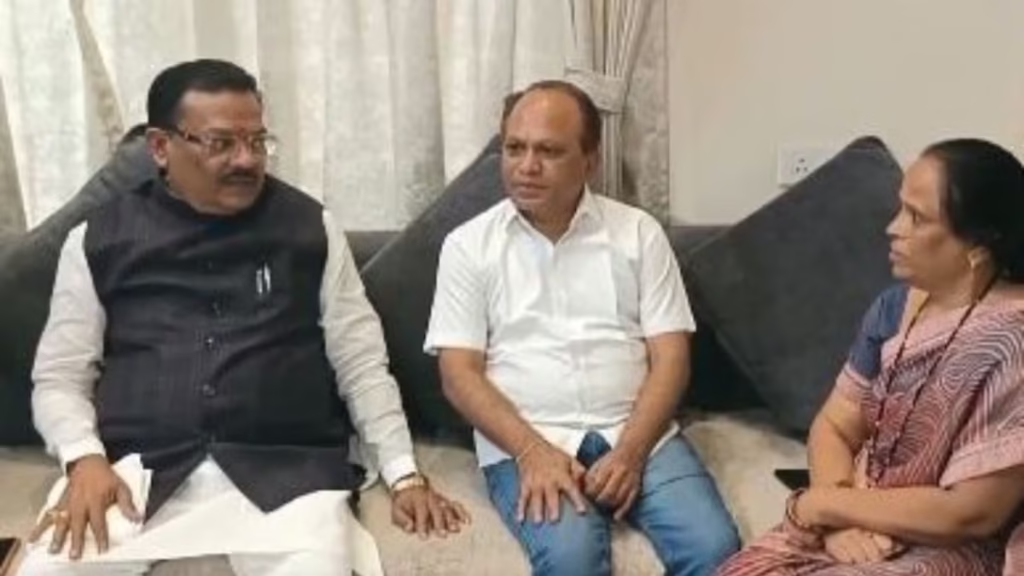
Mahayuti Alliance Faces Rising Heat: BJP-Shiv Sena Tensions Escalate Ahead of Maharashtra Power Struggle
MUMBAI — The political landscape in Maharashtra is witnessing growing turbulence within the ruling Mahayuti alliance, raising serious questions about the coalition’s internal stability. Tensions between the Bharatiya Janata Party (BJP) and the Eknath Shinde-led Shiv Sena faction have escalated rapidly over the past few weeks, recently boiling over in key local political hubs. As the state grapples with intense negotiations over power-sharing, portfolio allocations, and impending civic polls, the fundamental cohesion of the BJP-Shiv Sena-NCP (Ajit Pawar) coalition is being severely tested.
Grassroots Friction: The Kalyan-Dombivli Catalyst
The latest and most visible sign of discord has emerged from the political bedrock of the Mumbai Metropolitan Region—the Kalyan-Dombivli belt. Known as a traditional stronghold for the undivided Shiv Sena and a critical battleground for local dominance, the region is now ground zero for inter-alliance poaching and public grievances.
On Sunday, August 2, 2026, internal tensions flared publicly when several office-bearers belonging to Eknath Shinde’s Shiv Sena faction abruptly resigned and defected to the BJP. This move was not an isolated incident but rather a retaliatory strike; it followed a similar maneuver just days prior when BJP functionaries in the area had jumped ship to join the Shinde Sena.
The defecting Shinde Sena leaders, led by Archit Khadkul, did not leave quietly. Upon joining the BJP, they launched scathing attacks on their former party’s leadership, airing deep-seated grievances about marginalization and lack of upward mobility. Khadkul publicly alleged that loyal workers were systematically sidelined, stating, “Despite working tirelessly for the party, we were consistently ignored. We were not given appropriate positions at the right time.”
More alarmingly for the alliance’s health, Khadkul claimed that a senior leader of the Shinde faction had deliberately excluded specific office-bearers from crucial strategy meetings, fostering a toxic environment of distrust. This public airing of dirty laundry in a sensitive constituency highlights the growing disconnect between the alliance’s top-level agreements and the fierce, competitive reality among local cadres on the ground.
The BMC Mayor Showdown and Resort Politics
The grassroots friction in Kalyan-Dombivli is merely a symptom of a larger, systemic struggle for dominance within the Mahayuti, particularly in the aftermath of the high-stakes Brihanmumbai Municipal Corporation (BMC) elections held earlier in 2026. While the BJP-led alliance managed to sweep the civic polls—dismantling the decades-long grip of the Uddhav Thackeray faction—the victory has morphed into a bitter internal power struggle over the coveted position of Mumbai Mayor.
The BJP emerged as the dominant force with 89 seats, while Eknath Shinde’s Shiv Sena secured a vital 29 corporators. This numerical reality has set the stage for intense bargaining. Reports indicate that the Shinde faction is demanding the Mayor’s post outright or, at the very least, a rotational formula that would allow their candidate to hold the position for half the term.
The situation recently escalated to the point of “resort politics,” a tactic usually reserved for tight assembly floor tests. Fearing aggressive horse-trading and poaching attempts—even from their own coalition partner—the Shinde Sena reportedly sequestered its 29 newly elected BMC corporators in a five-star hotel. Speculation reached a fever pitch when rumors circulated of an alleged ultimatum from the Shinde camp, warning that if their demands were not met, the fallout could threaten not just the state government, but potentially the central coalition as well. While top leaders have officially downplayed these dramatic claims, the underlying anxiety over the BJP asserting total dominance in Mumbai is palpable within the Shinde ranks.
The Burden of the ‘Triple-Engine’
The core of the Mahayuti’s current dilemma lies in the complexities of managing a “triple-engine” government. The alliance, forged out of necessity and rebellion, relies on a delicate balance between the BJP’s massive electoral machinery, Shinde’s claim to the true Shiv Sena legacy, and Ajit Pawar’s crucial NCP vote bank.
While this combination proved highly effective in neutralizing the opposition Maha Vikas Aghadi (MVA) during recent elections—aided heavily by populist welfare schemes like the Ladki Bahin Yojana and aggressive infrastructure pushes—it has created a top-heavy administration where every major decision requires exhausting consensus-building.
The BJP, riding high on its dominant numbers, is eager to consolidate its position and project Devendra Fadnavis as the undisputed face of the alliance. Meanwhile, Eknath Shinde, who holds the Chief Minister’s chair, is acutely aware that conceding too much ground—especially in Mumbai and its surrounding belts—could erode his party’s distinct identity and relegate his faction to a secondary role.
What Lies Ahead?
As the alliance navigates these choppy waters, hectic political parleys have become the norm in Mumbai. Separate meetings between party leaders and their respective newly elected representatives suggest a strategic distancing, as each faction assesses its leverage.
The immediate challenge for the Mahayuti leadership is to contain the localized brushfires, like the one in Kalyan-Dombivli, before they trigger a wider conflagration. The BJP high command will need to walk a tightrope—satisfying its own ambitious cadres who feel entitled to the spoils of victory, while ensuring that the Shinde Sena does not feel suffocated or politically cannibalized by its larger partner.
With significant infrastructure projects underway and the shadow of state assembly dynamics always looming, the Mahayuti cannot afford prolonged internal instability. Whether the current tensions are merely the growing pains of a complex coalition or the early tremors of a structural cracking remains to be seen. However, one thing is certain: the honeymoon period for the triple-engine government is officially over, and the battle for internal supremacy has begun.